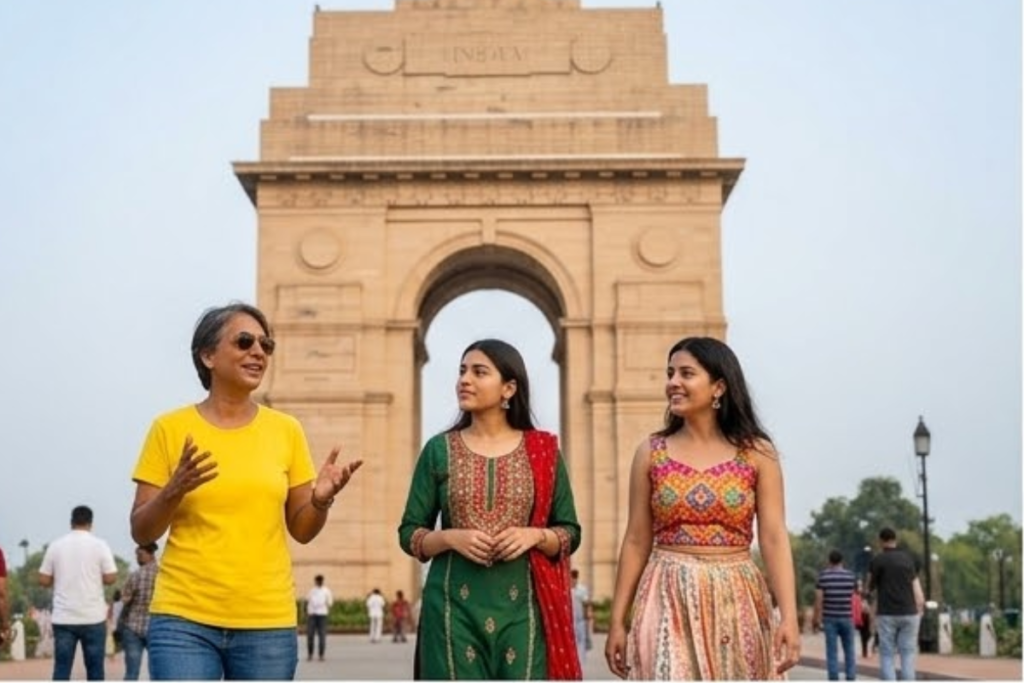
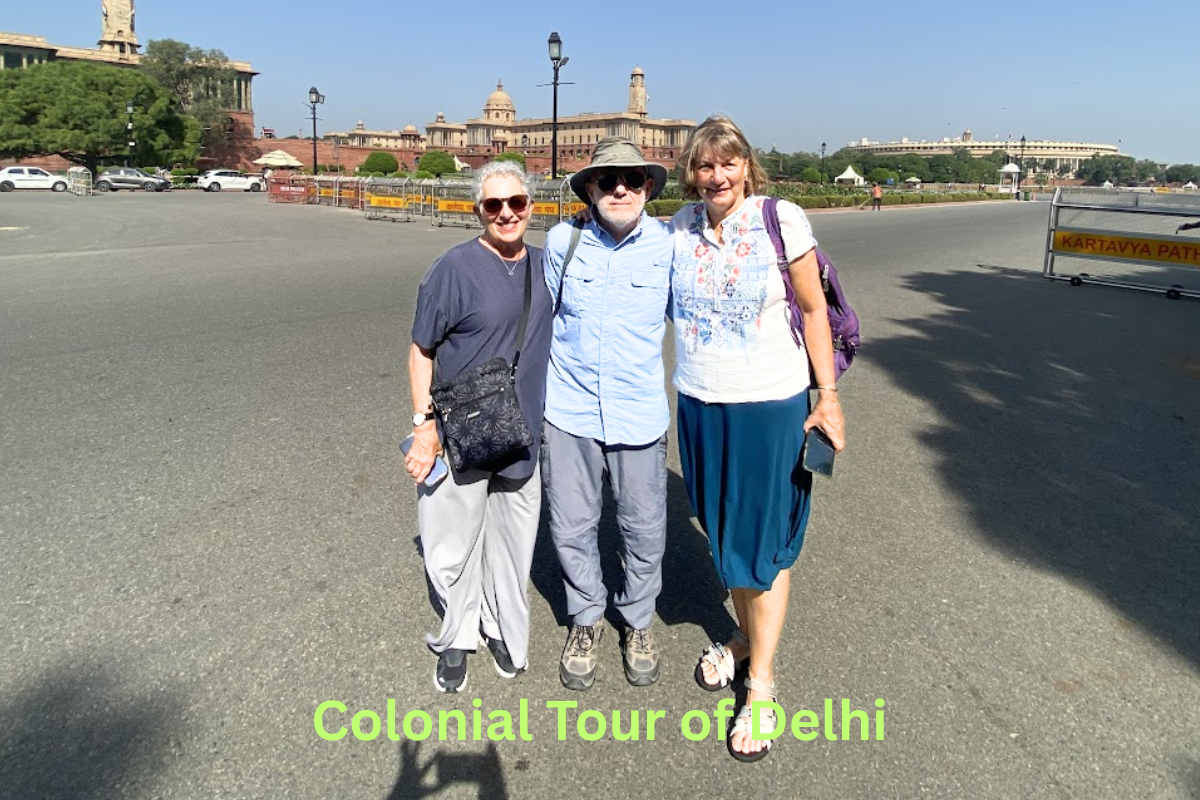
India Gate Delhi is one of the most iconic war memorials in India, and exploring it with a local guide makes the experience even more meaningful.
The streets, the people, the energy—Delhi had its own rhythm, and we were just beginning to understand it.
We had heard whispers among students about a charming senior—a historian who worked as a Delhi tour guide, someone who didn’t just show places but made you feel them.
His name was Harry.
How to Reach India Gate Delhi by Metro – A Journey Begins
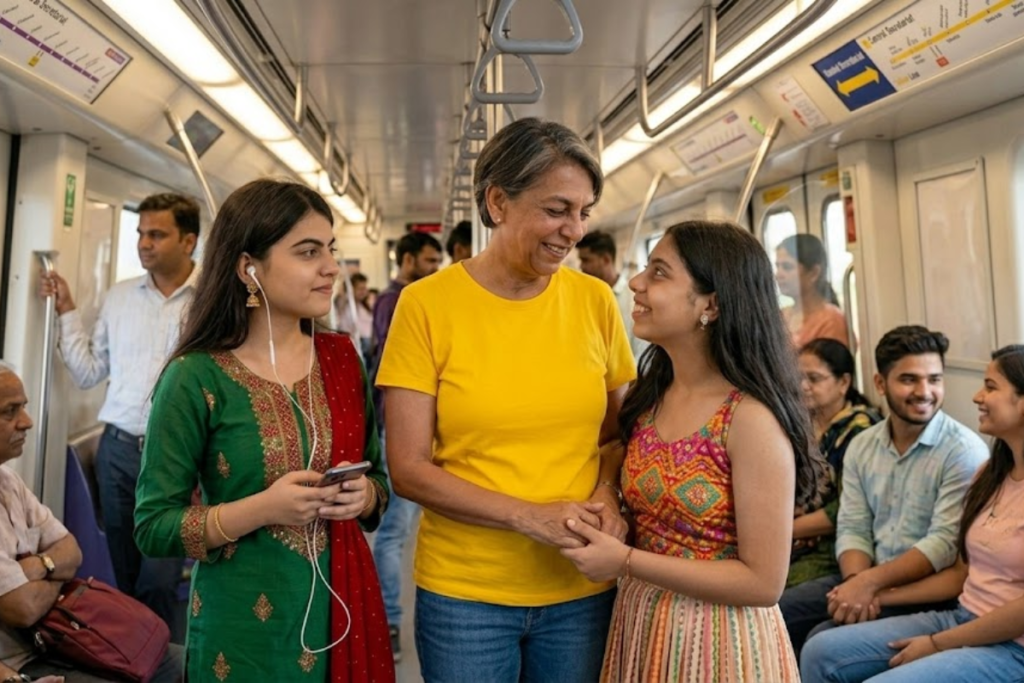
Our journey started on the Yellow Line of the Delhi Metro.
As the train moved through the city, Harry introduced himself—not just as a professional Delhi tour guide, but as someone deeply in love with the history and soul of Delhi.
His voice was calm yet captivating. Every word he spoke carried warmth, and every story he shared made us feel less like strangers and more like explorers discovering something magical.
But it wasn’t just information—it was the way he spoke.
His words painted pictures. His stories carried life.
I was completely mesmerized.
Poonam leaned closer to me and whispered softly, “Kiran… I think I’m falling in love with Delhi. I want to see everything.”
And in that moment, I realized I felt the same.
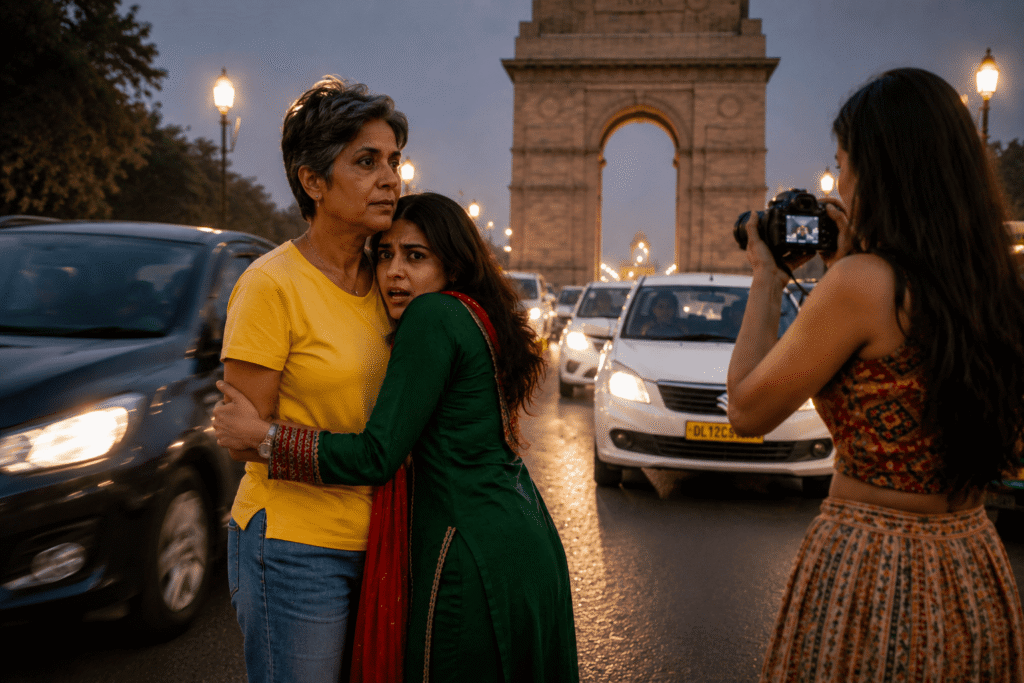
We crossed the underpass, and suddenly, there it was—standing tall, silent and powerful in front of us.
India Gate.
For a few seconds, we didn’t speak.
We just stood there, taking it all in.
India Gate Delhi History by My Delhi Tour Guide – A Living Colonial Story
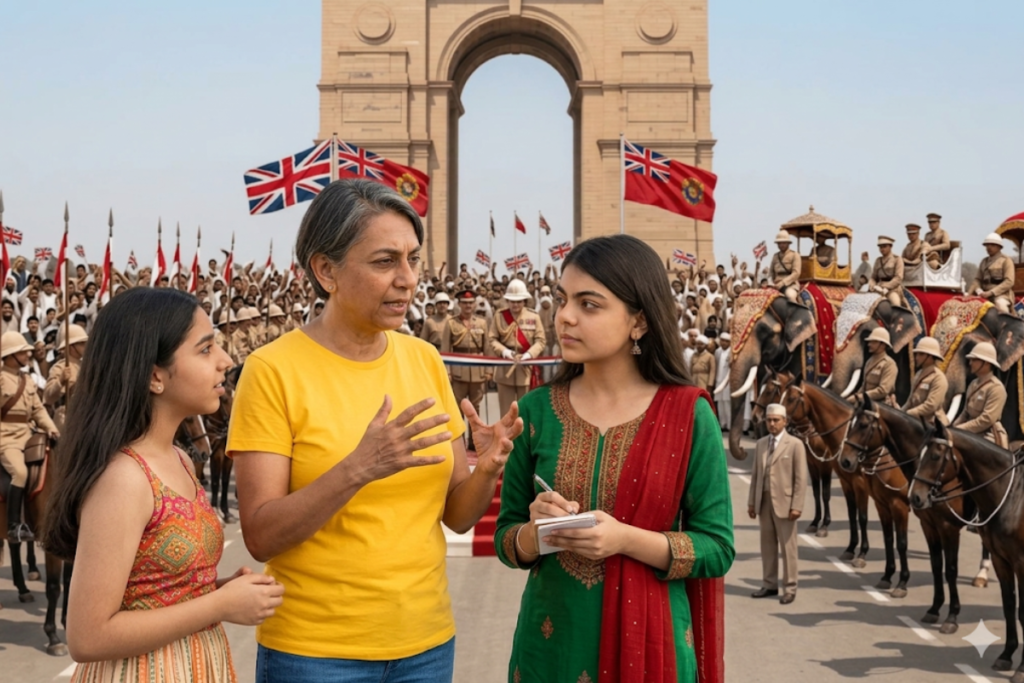
As we stood before India Gate, Harry didn’t simply begin explaining dates and facts. He brought the history of Delhi to life.
The warm evening breeze moved gently around us, and for a moment, it felt as if time itself had slowed down—as if the past was quietly unfolding in front of us.
“New Delhi was formally established as the capital after the British government announced the transfer of the capital from Calcutta to Delhi in 1911,” Harry explained.
He pointed toward the great ceremonial avenue stretching away from India Gate.
“This entire area was planned as the heart of the new imperial capital.”
He told us about Sir Edwin Lutyens and the monumental architecture of New Delhi. The broad avenues, government buildings, gardens and grand residences had all been designed to create a city worthy of the British Empire.
At the far end of the ceremonial axis stood the building that is now Rashtrapati Bhavan, once the Viceroy’s House.
Standing there, I felt like I was no longer just a student visiting a monument.
I was a silent witness to history.
The Story Behind India Gate
Harry then gestured toward the massive sandstone arch rising before us.
“This is India Gate,” he said. “It was designed by Sir Edwin Lutyens Wiki and completed in 1931.”
He explained that the monument was originally known as the All India War Memorial.
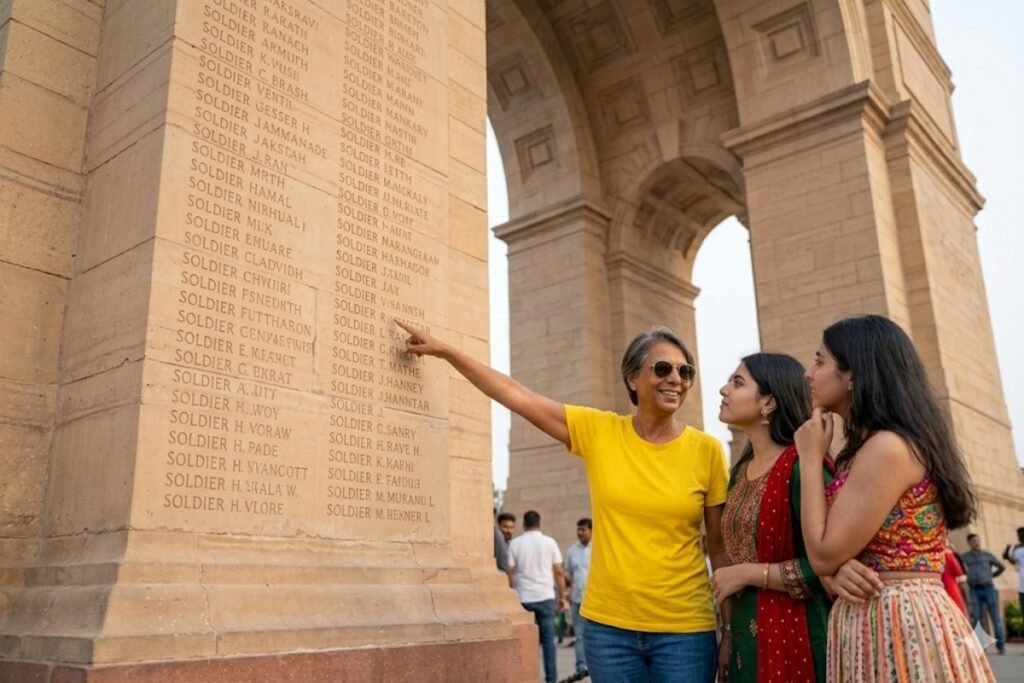
It commemorates Indian soldiers who died while serving in the British Indian Army during the First World War and the Third Anglo-Afghan War.
Harry pointed toward the inscriptions on the monument.
Thousands of names are remembered here.
These soldiers had fought in distant places such as Mesopotamia, Gallipoli, Persia, East Africa and along the Northwest Frontier.
For a moment, the monument felt different.
These were not simply names carved into sandstone.
They were sons, brothers and husbands who had once lived ordinary lives before being sent thousands of kilometres away from home.
I looked up at the enormous arch.
India Gate was no longer simply a beautiful monument.
It was memory.
It was sacrifice.
It was a complicated chapter of India’s colonial history.
Standing beside Harry, my Delhi tour guide, I wasn’t just listening to history.
I was feeling it.
The Canopy Behind India Gate Delhi – From King George to Netaji
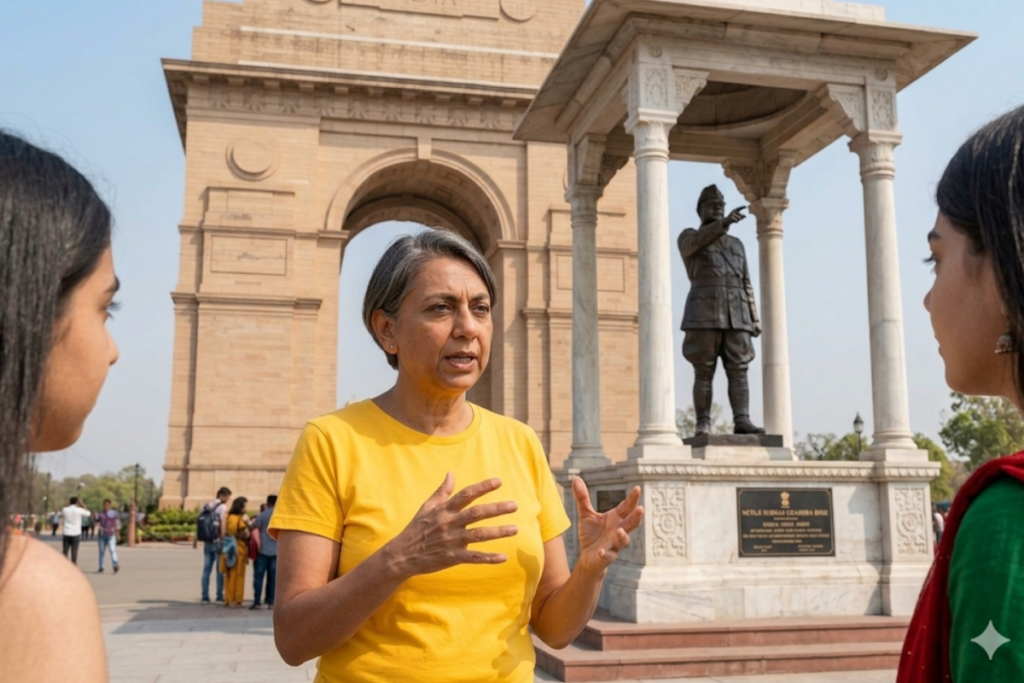
We slowly walked toward the grand sandstone canopy behind India Gate.
At first glance, it looked beautiful yet strangely incomplete—like a story waiting to be told.
Harry noticed us looking at it.
“This canopy has its own history,” he said.
The canopy was built to house a statue of King George V, representing the British Crown and imperial authority in the new capital.
After India’s independence in 1947, the statue was removed. It was later relocated to Coronation Park in Delhi, while the canopy remained empty for decades.
Then history turned another page.
In 2022, a statue of Netaji Subhas Chandra Bose was unveiled beneath the canopy.
Harry looked at us.
“Think about the change,” he said. “A space that once represented the British Crown now honours one of India’s great freedom fighters.”
We stood quietly.
The stone had remained.
But its meaning had changed.
The canopy had become part of a different India—a free India.
For me, that was one of the most powerful lessons of our India Gate walking tour.
History doesn’t always disappear.
Sometimes, it changes meaning.
Amar Jawan Jyoti at India Gate Delhi – A Silent Flame
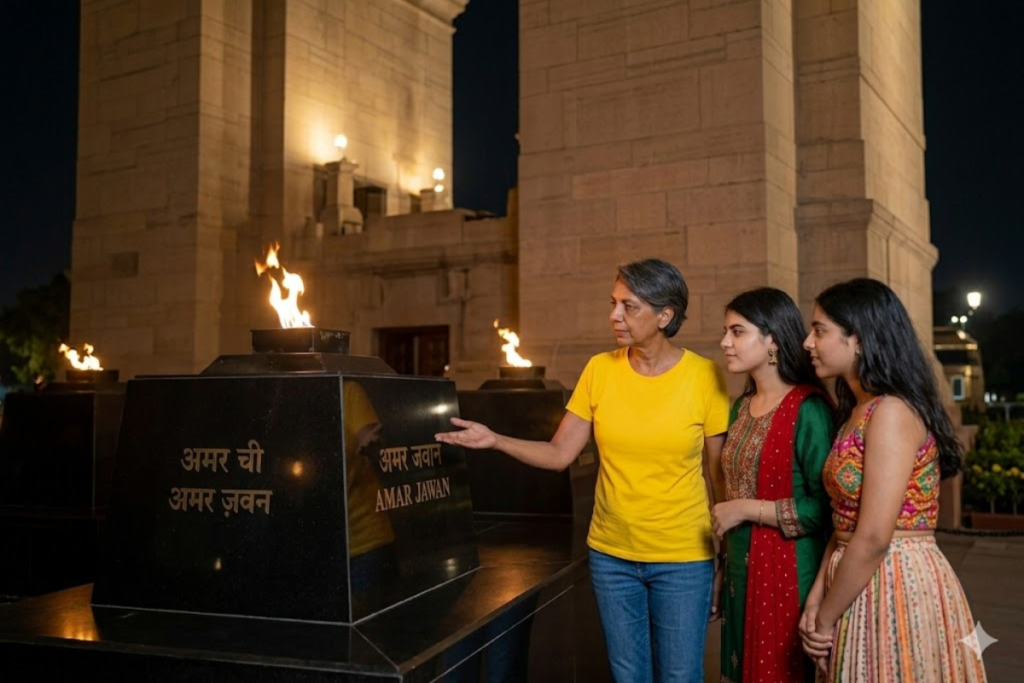
We walked back toward the memorial and stopped near the Amar Jawan Jyoti.
Before us stood the black marble memorial, with a reversed rifle crowned by a soldier’s helmet and the eternal flame.
Harry’s voice became quieter.
“The Amar Jawan Jyoti was established in 1972 to honour Indian soldiers who died in the 1971 Indo-Pakistani War.”
The flame flickered steadily.
The monument around it was enormous, but the small flame somehow held our attention more than anything else.
It represented remembrance.
It represented a soldier who never came home.
For the first time that evening, neither of us spoke.
No questions.
No laughter.
Just silence.
Standing there, I felt something I hadn’t expected when we began our walk.
Not excitement.
Not curiosity.
Respect.
India Gate Delhi was no longer just a place we had come to photograph.
It had become a place of emotion, sacrifice and remembrance.
Princely Houses Around India Gate Delhi – Echoes of the 1911 Delhi Durbar
Our walk continued around the central area of New Delhi.
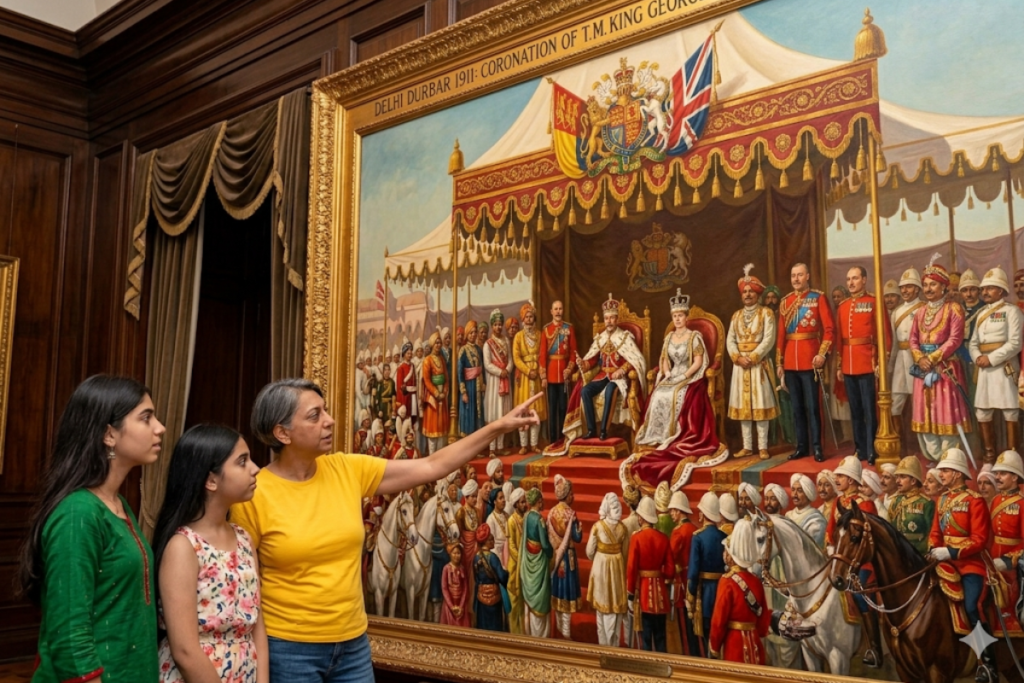
Harry pointed out the grand residences and buildings surrounding the ceremonial zone and explained how the area reflected the political and social world created around the new imperial capital.
He told us about the Delhi Durbar of 1911, when King George V and Queen Mary came to India and the decision to shift the capital from Calcutta to Delhi was announced.
The new city was planned on an enormous scale.
The roads, gardens, residences and monumental buildings were designed to project the power of the British Empire.
But history rarely remains frozen.
The same city that was built as the capital of an empire became the capital of independent India.
The same ceremonial spaces that once witnessed imperial pageantry now belong to a democratic republic.
Standing there, surrounded by these reminders of another era, I felt like a silent observer of a forgotten world.
Delhi suddenly seemed much bigger than the buildings around us.
India Gate Delhi in the Evening – City Comes Alive
By now, evening had settled over Delhi.
The lawns were filling with families.
Children were running across the grass. Couples were walking together. Vendors were calling out to visitors.
India Gate was beginning to glow against the darkening sky.
Traffic moved around the wide roads while the lawns remained surprisingly peaceful.
This was Delhi in its most beautiful form.
Not just monuments.
Not just history.
Life.
Harry had somehow connected everything for us—the British Raj, the creation of New Delhi, the soldiers remembered at India Gate, the struggle for independence and the India we see today.
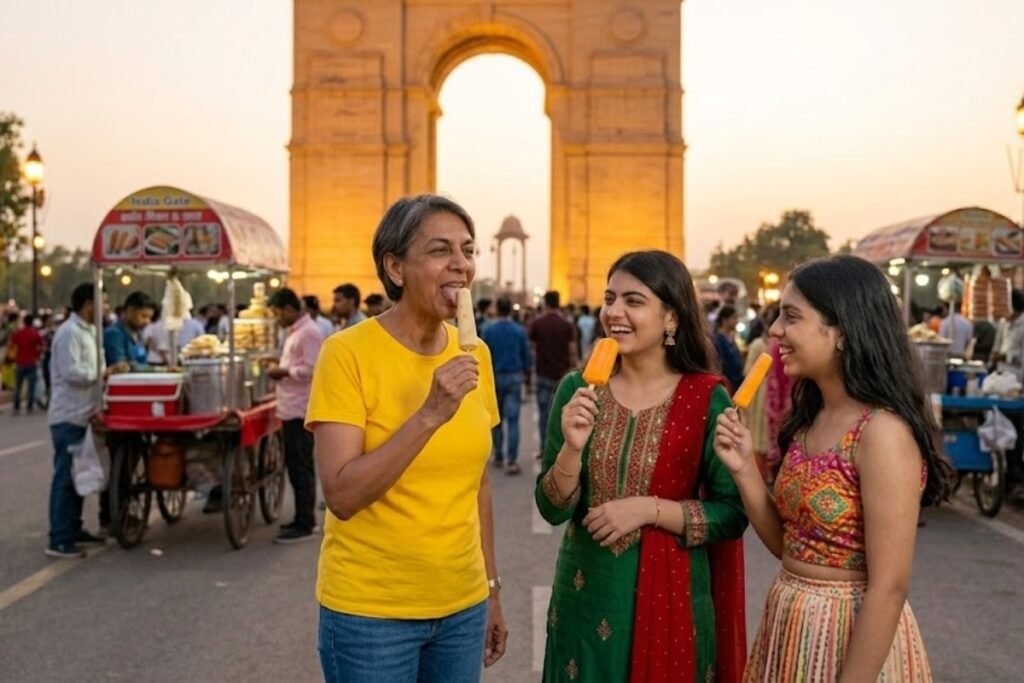
Then, just when the evening had become serious and thoughtful, Harry surprised us with something wonderfully simple.
Ice cream.
We sat on the lawns, enjoying the cool evening and laughing about everything we had seen.
Poonam looked at me.
“Today was supposed to be a walking tour,” she said.
I smiled.
“It became much more than that.”
She was right.
Exploring India Gate Delhi with a Local Companion
Our India Gate walking tour had begun with a Metro journey and a monument we thought we already knew.
But by the time we left, India Gate had become a story.
A story of empire.
A story of soldiers.
A story of sacrifice.
A story of independence.
And a story of how Delhi keeps changing while carrying its past with it.
That evening taught me something about travelling.
Sometimes you don’t need another photograph.
You need someone who can tell you what happened here.
Harry wasn’t simply showing us India Gate.
He was helping us understand Delhi.
Back at the Hostel – Reliving Our India Gate Delhi Evening
It was late when Kiran and I finally returned to our hostel.
We were tired after the long walk, but neither of us was ready to sleep.
We sat together on the bed, our phones between us, scrolling through the photographs we had taken that evening.
There was one of us standing in front of India Gate.
Another showed Harry explaining the history beneath the great arch.
Then came photographs of the canopy, the evening lights and the lawns filled with people.
We kept scrolling.
“Look at this one,” Poonam said, laughing.
I looked at the screen and smiled.
The photograph showed India Gate glowing against the evening sky.
But somehow, the picture didn’t capture what we had actually experienced.
A photograph could show the monument.
It couldn’t show the stories Harry had told us.
It couldn’t capture the silence we felt standing beside the Amar Jawan Jyoti.
It couldn’t explain the strange feeling of standing beneath a monument built during the British Raj and learning how its meaning had changed after India’s independence.
Poonam put her phone down for a moment.
“You know,” she said, “before today, India Gate was just a famous place I wanted to photograph.”
“And now?” I asked.
She smiled.
“Now I know its story.”
I looked at the photographs again.
Perhaps that was what made our evening with Harry different.
We hadn’t simply visited India Gate.
We had walked through a part of Delhi’s history.
We had heard about the British Raj, the soldiers remembered on its walls, the creation of New Delhi, the transformation after independence and the people who shaped modern India.
Outside our hostel window, Delhi was still awake.
The city continued with its familiar rhythm—traffic, voices, lights and distant sounds.
I turned off my phone and looked at Poonam.
“Tomorrow?” I asked.
She smiled.
“Tomorrow we explore another part of Delhi.”
And that was how our Delhi adventure continued.
We had arrived at India Gate looking for a monument.
We returned to our hostel carrying a story.
Sometimes, the best way to discover Delhi is not simply to see its monuments, but to walk with someone who knows the stories hidden behind them.