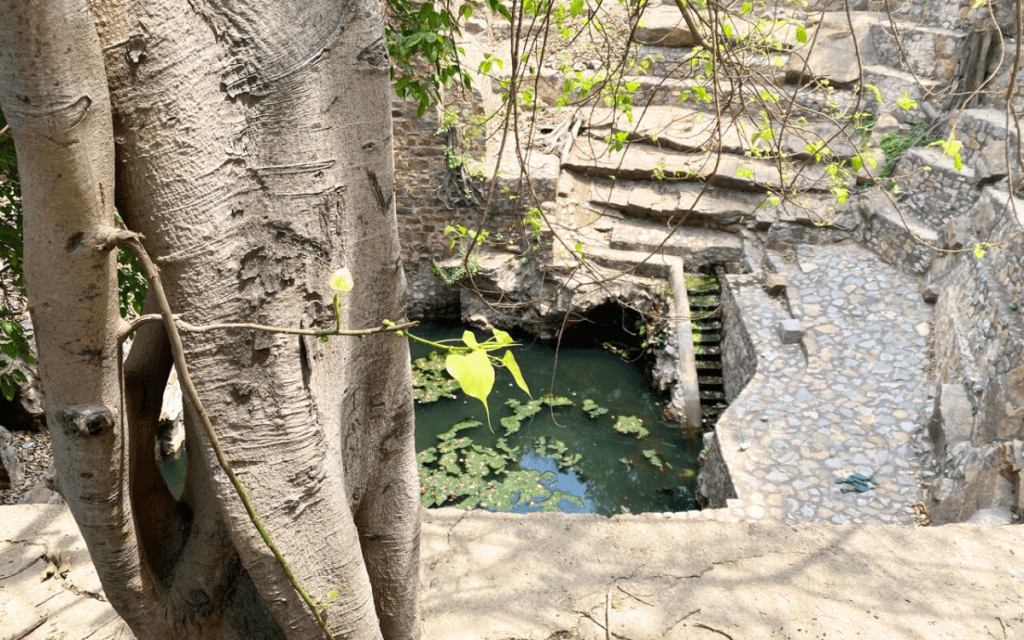
The Pir Ghaib Delhi Dargah structure and ancient Baoli (stepwell) in Kamala Nehru Ridge stand as one of the capital’s most intriguing abandoned places. Walk with Harry into the quiet Delhi Ridge and uncover the forgotten story of Pir Ghaib, its mysterious saint and hidden Baoli. Harry to delve deep into the mysterious stories of the Sultan, the vanishing Pir Ghaib, and this forgotten stepwell. Tucked away in the Ridge forest, these secluded ruins offer a fascinating glimpse into Delhi’s rich past and the ingenuity of its medieval rulers.
Pir Ghaib Delhi: Interesting History of Tughlaq Sultan
Imagine a time, around 1630 AD, when this area teemed with wildlife as part of the ridge jungles. Sultan Firoz Shah Tughlaq, a visionary ruler of Delhi, built the Pir Ghaib – a two-story structure. This fascinating building served a dual purpose: a forest hunting lodge for the sultan since this area was part of the ridge jungles and had a lot of wildlife and and it also served as an observatory, evident from the strategically placed holes in the ceiling and roof.
Join local expert Harry to uncover the eerie, forgotten legend of Pir Ghaib. As Harry leads you past the ancient sandstone walls of this abandoned ridge monument, you’ll feel the true weight of medieval history brought to life through personal stories. Step into the shadow of these quiet ruins and let your imagination wander — who knows, maybe the spirit of the vanishing saint still lingers in the quiet air?
Pir Ghaib Delhi Dargah: Mystery of the Missing Pir by Harry
Legends whisper of a Sufi saint who once resided in this two-story structure built by Firoz Shah Tughlaq. This holy man was known for his piety and wisdom. One fine day, while meditating in the building, he vanished without a trace!
The locals were baffled. Had he ascended to the heavens? Did he simply walk away? The mystery surrounding his disappearance has endured for centuries, giving the building its current name – Pir Ghaib.
Archaeological evidence adds another layer to the story. A cenotaph discovered within the structure suggests the presence of a saint who used it as a place of worship. Perhaps this is the very man who mysteriously disappeared.
The book “The Delhi That No One Knows,” written by Historian R.V. Smith, offers another fascinating story. He claims the saint belonged to nobility and contemplated ending his life after his wife’s death. However, a wise mendicant intervened, introducing him to Sufism, a mystical branch of Islam. The saint embraced this new path and found solace in his devotion to God.
One day, the saint’s devotees found his usual meditation spot empty. Had he truly disappeared into thin air? Or did he choose to live a life shrouded in secrecy? The answer remains a delightful mystery…
Some even believe the two chambers built around the hilltop by Firoz Shah Tughlaq were connected to the saint’s presence. One chamber even housed astronomical instruments, perhaps reflecting the saint’s interest in the cosmos.
Pir Ghaib Delhi a Hidden Baoli (Step Well) Story
Deep within the shadow of the Pir Ghaib lies another marvel – the Baoli, a stepwell as Agarsen ki Baoli in New Delhi, whispering tales of Sultans, weary travelers, and perhaps even Sufi mystics. Imagine yourself transported back to the 14th century, during the reign of Sultan Firoz Shah Tughlaq. A passionate hunter, the Sultan would often goes on expeditions with his nobles, setting up camp near the ridge jungles, teeming with wildlife.
The Baoli, built by Firoz Shah himself in 1354 AD, served as the lifeblood of these hunting camps. This wasn’t your ordinary well. Picture a magnificent octagonal structure, its steps and platform designed with a unique purpose – to make water easily accessible in this hilly terrain. The Sultan’s loyal attendants, the “khadims,” would diligently draw cool, refreshing water from the Baoli to quench the thirst of the royal party. The rhythmic creak of the rope and buckets would echoing through the air, a constant reminder of the Baoli’s vital role.
But the Baoli’s significance extended beyond the Sultan’s sojourns. Sufi Pir, known for their spiritual wanderings, would often stop at the stepwell to refresh themselves. Imagine a wizened Sufi, his beard flecked with age, lowering himself down the steps, the cool water a welcome respite from the scorching Delhi sun. Perhaps he would even find solace in the quiet serenity of the Baoli, its stillness conducive to meditation and prayer.
Caravans laden would also find themselves drawn to the Baoli. After days traversing the dusty routes, the sight of the stepwell would be a beacon of hope, promising a chance to replenish their water supplies and soothe their weary bodies. The air would be filled with the boisterous chatter of merchants and the gentle clanging of camel bells and horses as they gathered around the Baoli, creating a vibrant tapestry of life. Even played a crucial role during the 1857 revolt. Legend has it that the British, fearing potential sabotage, guarded the Baoli closely!
Adding to its mystique, the Baoli boasts a hidden passage – a tunnel that burrows deep into the earth. No one knows where it leads, a testament to the ingenuity of the pre-Mughal era. This was long before Shah Jahan built the magnificent Red Fort, making the Baoli a silent witness to a bygone chapter in Delhi’s history.
Sadly, time has taken its toll on the Baoli and Pir Ghaib Delhi Today, the water level has receded, and vegetation creeps in from the edges. Join us on an Old Delhi Heritage Walk and delve deeper into the captivating stories with a little imagination.
Pir Gayab Delhi Nearby Attractions: Mutiny Memorial & Qudsia Bagh
Step into history with a guided walk to the nearby Mutiny Memorial (Ajit Garh) and the peaceful Mughal ruins of Qudsia Bagh. Wander through the quiet trails of the Northern Ridge and listen to eerie, fascinating stories of 1857 that still echo around these ancient monuments. Walking with local expert Harry brings every stone to life—uncovering lost summer palaces, battle-scarred gateways, and hidden Tughlaq ruins. It’s the ultimate experience for history lovers who crave real stories with a touch of mystery.