Jet-lagged but curious, David and I arrived in New Delhi from Canada, checked into our hotel at dawn, and collapsed into a deep sleep. By afternoon, revived with our first taste of Indian food, I searched for something light yet meaningful to do. That’s when the idea of a Lodhi Garden Tour appeared — just a short distance away, yet promising a journey through centuries.
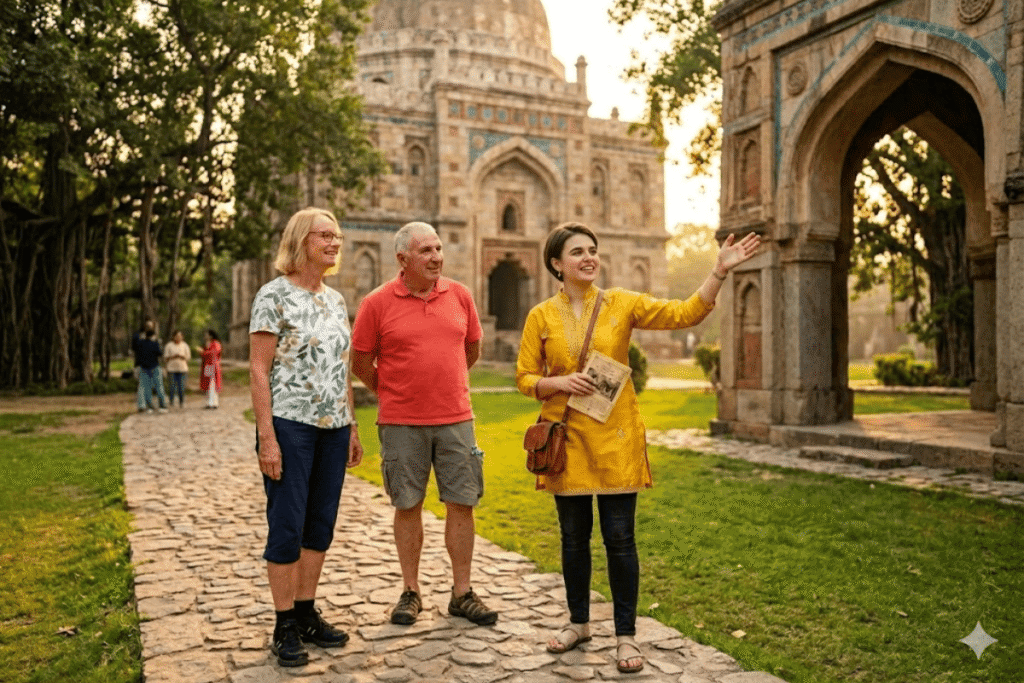
Within half an hour, our guide Harry walked into the lobby — warm, confident, and instantly reassuring. As we stepped into Lodhi Garden, the chaos of Delhi melted into calm. This wasn’t just a park; it was a living canvas of history where the last whispers of the Sultanate still echo through ancient domes and pathways. Nestled between Khan Market and Safdarjung Tomb, the Lodhi Garden Heritage Walk felt like stepping into a different world — where locals practice yoga under old trees, joggers pass by quietly, and every monument tells a story waiting to be discovered.
A Lodhi GardenTour is one of the best things to do in New Delhi for tourists seeking a mix of history, nature, and local life. Spread across 100 acres in the heart of Lutyens’ Delhi, Lodhi Garden is a peaceful green escape surrounded by elegant colonial bungalows. This heritage walk lets you explore 15th-century Sultanate monuments, beautiful pathways, and lush landscapes all in one place.
Perfect for morning visits, the Lodhi Garden Walk offers more than sightseeing — it gives you a glimpse of everyday Delhi. You’ll see locals jogging, families enjoying walks, young mothers with their babies, and yoga sessions under ancient trees. For tourists, it’s an easy, safe, and refreshing way to experience Delhi’s culture while discovering its rich architectural past.
Lodhi Garden Walk Timings: 6:00 am to 7:00 pm (April to September); 6:30 am to 7:00 pm (October to March)
If You Like to Read More: Lodhi Dynasty on Wikipedia
Lodhi Garden Heritage Walk: Muhammad Shah’s Tomb – Where It All Began
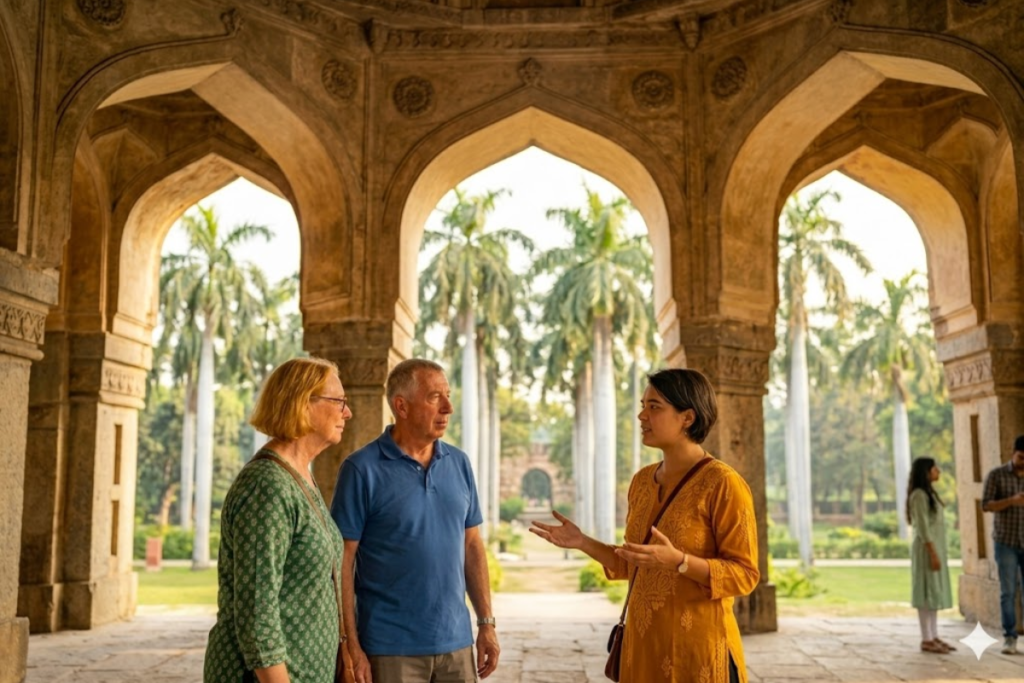
We found ourselves returning to the octagonal beauty of Muhammad Shah’s tomb, now glowing warmer as the sun began to dip. Harry added more layers to the story — of a ruler whose reign saw decline, yet whose resting place stood with quiet dignity. Built around 1444–1451 to honor the third ruler of the Sayyid Dynasty, the tomb’s octagonal form reflected the signature style of the period, with sloping buttresses at each corner. As Harry pointed out, the central chamber is surrounded by an airy verandah of arched openings, while inside, delicate stucco patterns — circular designs, arabesques, and calligraphy — still whisper stories of the past. Within, eight graves rest silently, the central one believed to be that of Muhammad Shah himself.
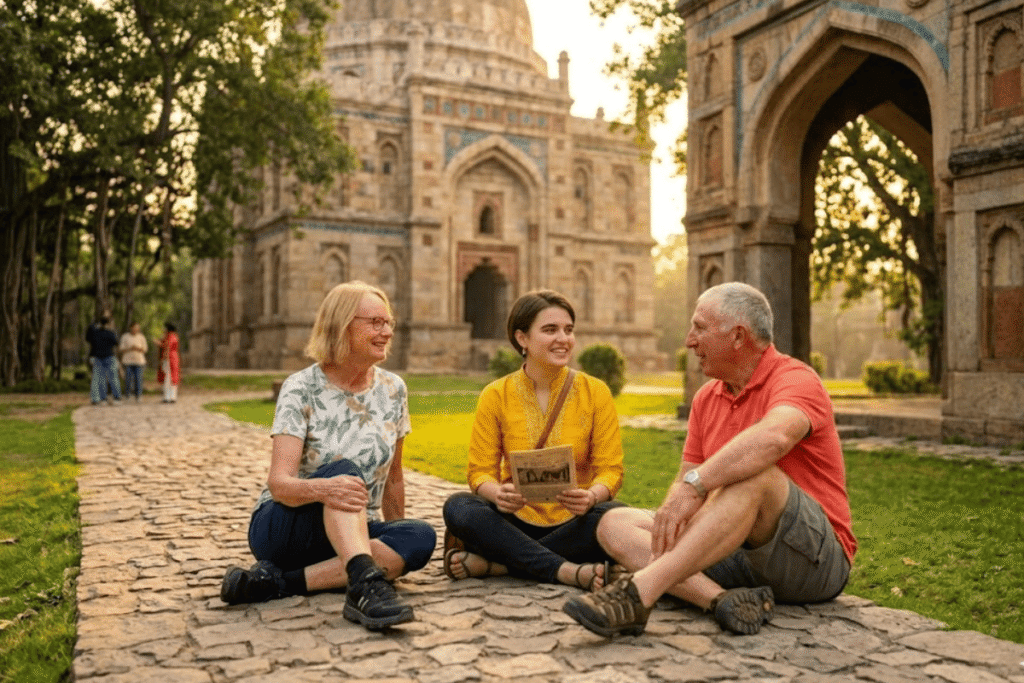
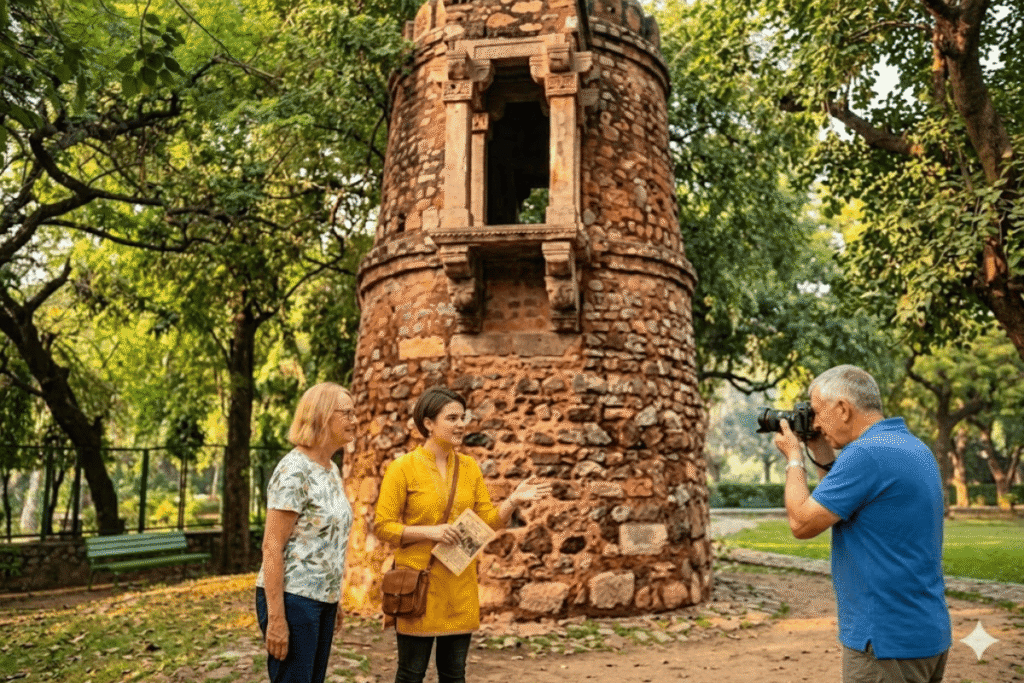
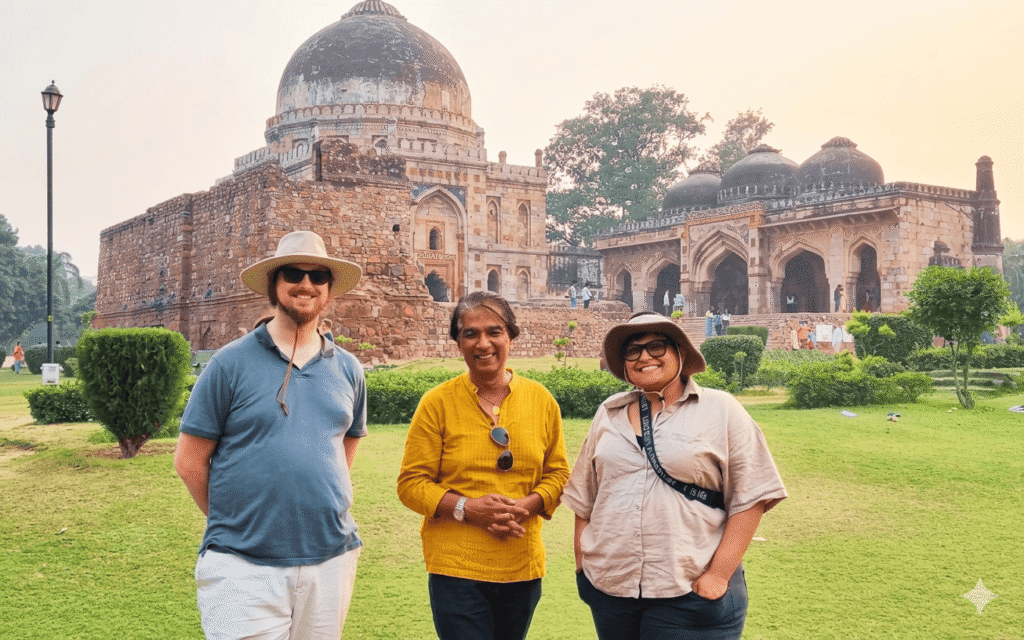
David clicked a few candid photos — one of me smiling at Harry, another where I was lost in thought. Later, I realized these were not just pictures, but emotions captured during our Lodhi Garden Tour.
History, when told like this, didn’t feel distant anymore. It felt human.
Lodhi Garden Tour with Local Guide: A Storyteller
On our Lodhi Garden Walk, Harry led us beneath swaying palm trees to a striking octagonal tomb glowing softly in the evening light. As we paused, he began weaving the story of Lodhi Sultans of the Delhi Sultanate. His voice carried the past into the present, turning silent stones into living history.
Standing there in what was once the village of Khairpur, now part of Lodhi Garden Formerly Known as Lady Willingdon Park wife of Lord WILLINGTON Viceroy of India 1931 – 1936 , it felt surreal to imagine a fallen sultan resting beneath the same sky. While Harry spoke, David quietly captured candid moments — a smile, a glance, a story unfolding — making our Lodhi Garden Tour not just a tour, but a memory stitched with history and emotion.
Lodhi Garden Tour: Bara Gumbad Complex – Where Stories Echo in Stone
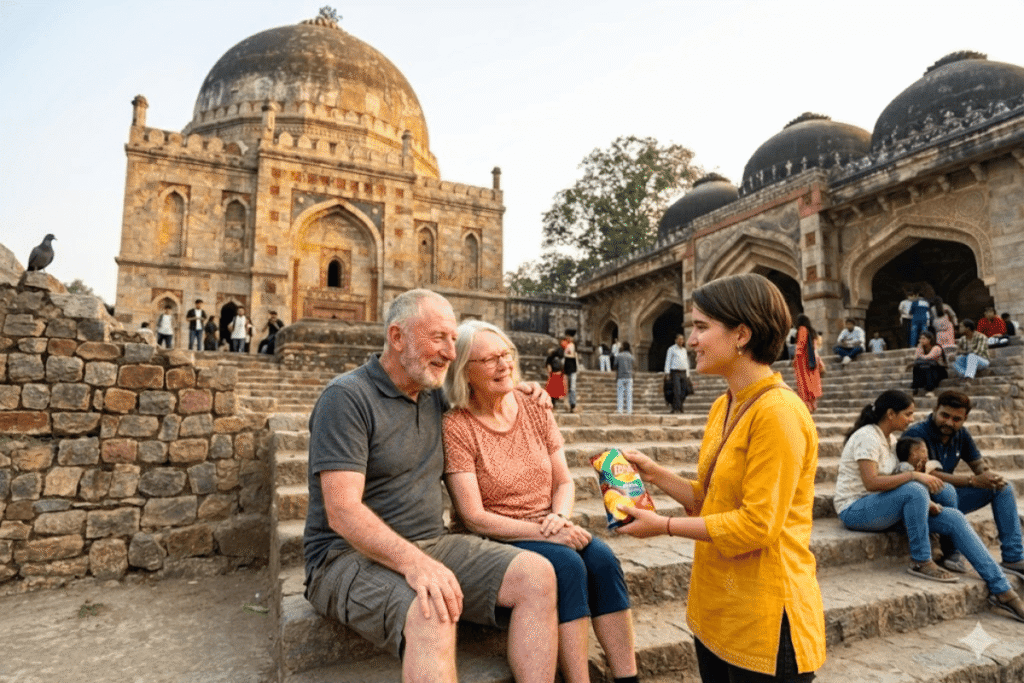
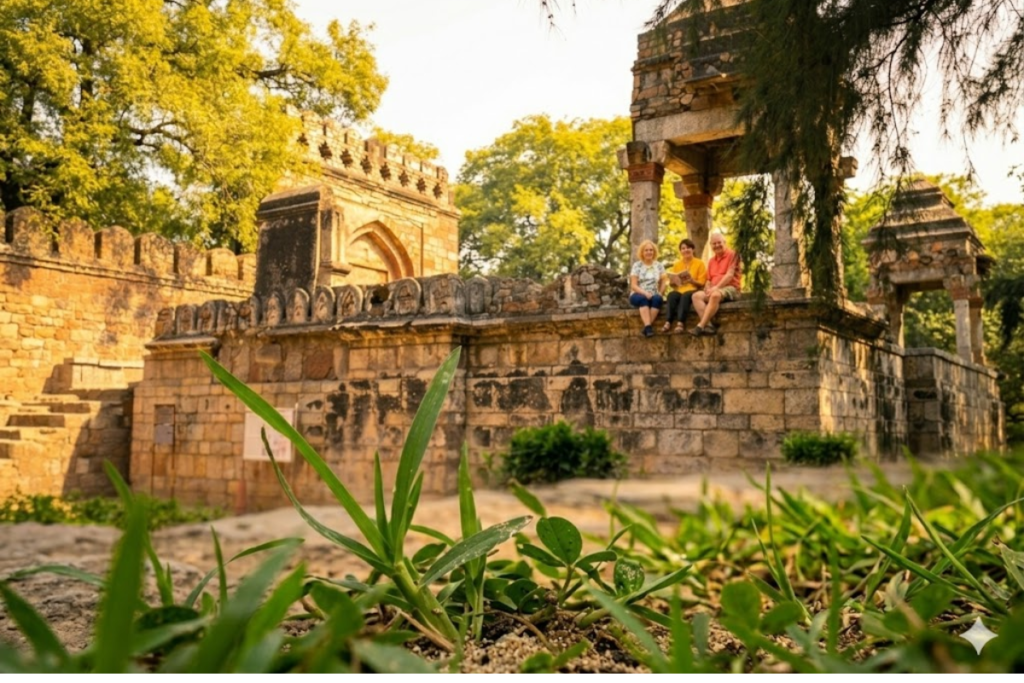
As our Lodhi Garden Tour moved deeper into the garden, Harry guided us toward the magnificent Bara Gumbad Complex. Built in 1490 CE, the Bada Gumbad is believed to have one of the earliest full domes in Delhi. The grand structure stood like a silent guardian of time, possibly raised by an unknown noble and later used by Sikander Lodi as a gateway to his mosque or a large walled enclosure. The nearby mosque revealed delicate plasterwork that seemed too intricate for its age, while scholars like Simon Digby suggest the complex once connected spaces like the Shisha Gumbad, believed to be the tomb of Bahlul Lodi.
David stood still, completely absorbed, his eyes shifting from the carvings to Harry — listening, watching, trying to capture every word and detail.
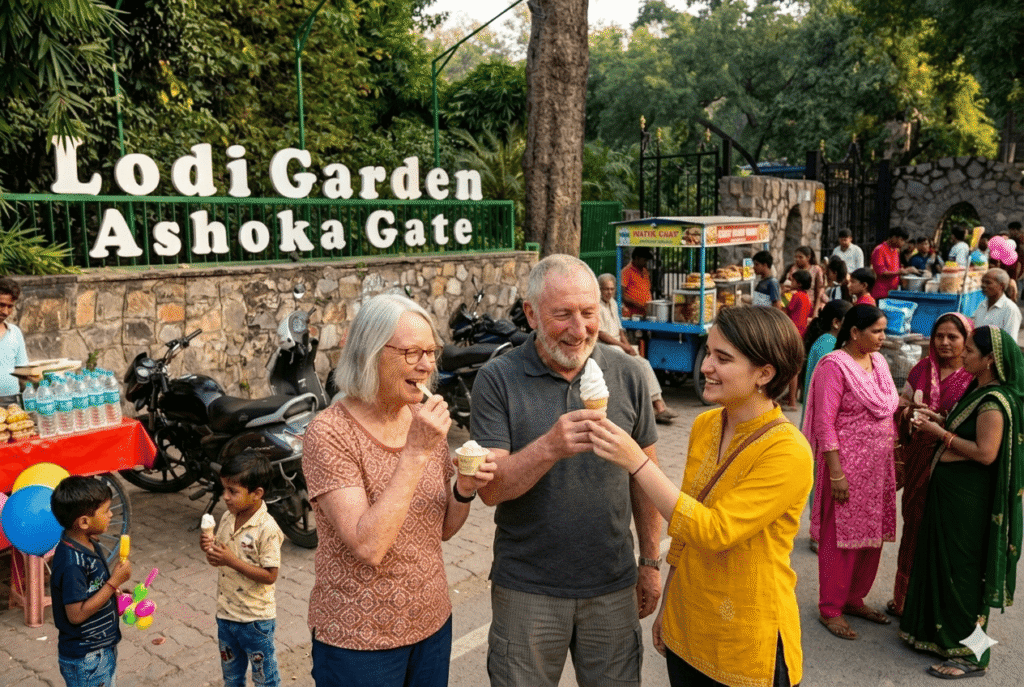
Harry smiled and said, “This wasn’t just a monument, it was a space of gathering, of prayers, of conversations.” As we paused near the Mehman Khana, Harry offered us some local snacks — and for a moment, it felt like we were travelers of the past, resting in the same spirit. The Mehman Khana added another layer — a place where travelers once paused on their journeys, much like us, lost between history and the present.
Shisha Gumbad – The Mystery of the Blue Tiles at Lodhi Garden Tour
We continued our Lodhi Garden Heritage Walk toward the Shisha Gumbad, its fading blue tiles still shimmering under the soft Delhi light. “Once, this must have sparkled like glass,” Harry explained, pointing toward the traces of glazed tiles.
David leaned slightly closer, curiosity written all over his face as he looked at Harry — completely drawn into the story. Who were the people buried here? A royal family? Nobles of the court? The mystery added a quiet thrill to the moment.
Around us, parrots chirped, and a gentle breeze moved through the trees. It wasn’t just history we were experiencing — it was a living, breathing atmosphere that made the Lodhi Garden Tour unforgettable.
Lodhi Garden Walking Tour: Sikandar Lodi Tomb – Power, Peace, and Silence a
As we walked further, the path opened into a fortified enclosure — the Tomb of Sikandar Lodi. Unlike the others, this space felt more private, more protected. Harry explained how it was built by Ibrahim Lodi in 1517, a tribute from a son to his father.
David’s camera slowly lowered. He wasn’t taking pictures now — he was just listening. Watching Harry. Absorbing the silence.
Inside the walls, the air felt different. Calm. Almost sacred. Gardens surrounded the tomb, reminding us of the Mughal-style charbagh concept that symbolized paradise. Harry’s storytelling made it easy to imagine royal processions, prayers, and moments of solitude that once filled this very place.
This part of the Lodhi Garden Tour felt deeply personal — a connection between power and peace.
Lodhi Garden Walk: Athpula Bridge – A Mughal Connection
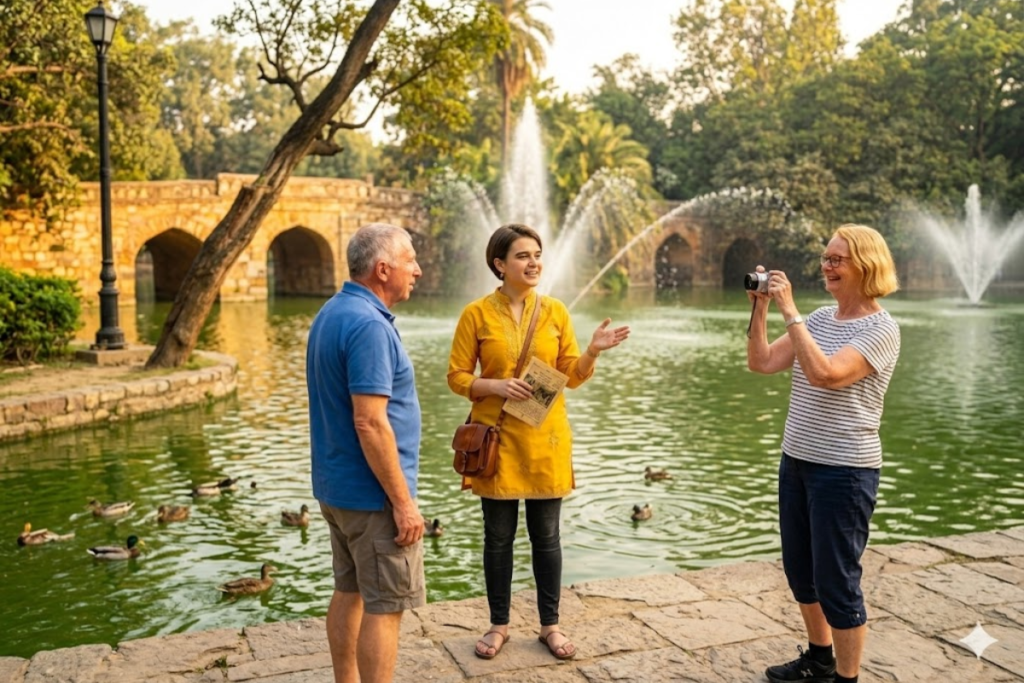
As we moved ahead, Harry led us to the charming Athpula — the eight-pillared bridge built during Akbar’s reign. Beneath it, a small water body reflected the changing sky.
“This came after the Lodis,” Harry said, connecting timelines effortlessly.
David looked at him again, that same expression of interest and admiration. It was fascinating how one walk could move across dynasties — from the Sayyids to the Lodis to the Mughals — all within a few peaceful steps.
The bridge felt like a symbol — connecting not just land, but centuries of history.
Hidden Details in Lodhi Garden Tour– Kos Minar, Birds & Living Art
The beauty of the Lodhi Garden Heritage Walk wasn’t just in the big monuments. Harry pointed out a small turret-like structure — a Kos Minar, once used as a distance marker built during the reign of Sher Shah Suri. These turrets once dotted the historic Grand Trunk Road, guiding traders and caravans across the empire from Amritsar to Kolkata. Harry smiled and added how Sher Shah Suri was later defeated by Humayun, the second Mughal emperor, whose magnificent tomb still stands just across the road — a reminder of how history quietly connects across Delhi.
As we walked, we noticed more — vibrant birds resting on branches, couples sketching monuments, artists capturing shadows and light. The garden felt alive in every sense.
David whispered, “This place is not just history… it’s life.” And he was right.
A Lodhi Garden Walking Tour: Experience Monuments to Moments
As the evening settled in, our walk slowly came to an end. But something had changed. What started as a simple plan for an evening had turned into a journey through time, emotions, and stories.
Harry wasn’t just a guide — he was a storyteller who made Delhi speak. And David, who began as a curious traveler, was now deeply connected, looking at Harry not just with interest, but with admiration for the stories he carried. I heartily recommend choosing an expert Delhi tour guide if you truly want to experience the city beyond its surface.
The Lodhi Garden Heritage Walk gave us more than monuments — it gave us moments. Moments of silence, curiosity, beauty, and connection.
And as we walked out, I realized — some places you visit… but some places stay with you forever.
As the evening breeze touched the gardens, David asked about nearby places to unwind. He suggested the Old Delhi Heritage Walking Tour, describing how the historic neighborhood transforms in the evening as glittering bazaars light up, narrow streets pulse with vibrant energy, and centuries-old havelis glow under the night sky, revealing a completely different but equally charming side of the capital.”
What Visitors Say About the Lodhi Walk
⭐⭐⭐⭐⭐ We had a lovely Lodhi Garden Heritage Walk with Harry. The experience was calm, informative, and a perfect blend of history and nature. Harry’s storytelling made the monuments come alive while we enjoyed the peaceful greenery. I highly recommend this walk to anyone visiting Delhi — especially in the evening for a truly relaxing and memorable experience. George Australia
Nearby Places to Visit After Lodhi Garden Heritage Walk
As our Lodhi Garden Heritage Walk unfolded, Harry pointed beyond the trees and reminded us that this part of Delhi is a living corridor of history. Just a short distance away stands the gracefulSafdarjung Tomb, often called the last flicker of Mughal architecture, leading beautifully to the grandeur of Humayun’s Tomb, where perfect symmetry and royal gardens tell stories of empire and legacy. And as the evening deepens, the experience turns soulful at Nizamuddin Dargah, where the air fills with qawwali and devotion, offering a spiritual rhythm that completes the journey from history to heart.