If you are planning a journey through India’s most iconic travel circuit, the Golden Triangle Tour with Khajuraho Temples Extension offers an unforgettable way to elevate your experience beyond the usual highlights of Delhi, Agra, and Jaipur. This Golden Triangle Tour with Khajuraho Extension is designed to take travelers deeper into India’s cultural and artistic legacy, combining famous landmarks with hidden heritage gems. Maya included Khajuraho Temples on the Golden Triangle journey, making it an even more enriching itinerary that goes far beyond the standard route.
This extended itinerary adds the breathtaking Khajuraho Temples, world-famous for their intricate stone carvings, spiritual symbolism, and exceptional architectural brilliance. Each temple reflects the artistic mastery of the Chandela dynasty, showcasing stories of devotion, daily life, and divine expression carved into sandstone with remarkable precision.
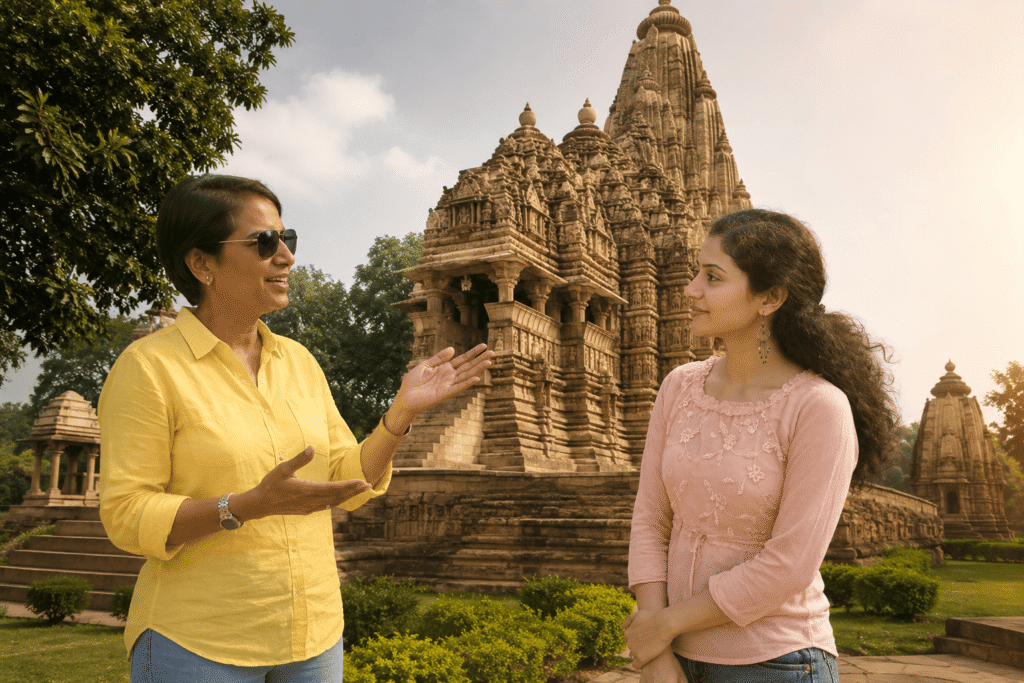
Maya explores the Khajuraho temples of Khajuraho with her Khajuraho tour guide, Harry.
By including Khajuraho in your Golden Triangle journey, you not only explore India’s most celebrated monuments but also uncover a UNESCO World Heritage Site that reveals a deeper layer of medieval Indian art and culture. This combination creates a travel experience that is both visually stunning and historically enriching, leaving visitors with a lasting appreciation of India’s diverse heritage.
The Legend of Khajuraho Temples by Golden Triangle Tour Guide
My journey to these ancient stones actually started weeks earlier. While studying at the Morarji Desai National Institute of Yoga, my friends and I had explored the historic streets of Old and New Delhi with Harry. Having already experienced his brilliant storytelling as our trusted Tour Companion, hiring him to come with us to Khajuraho was the best decision I could have made. Maya United States
As we walked through the temple complex, Harry told us a beautiful Chandela legend about the origins of Khajuraho.
According to the story, Hemvati was a beautiful young woman who was bathing one night when the Moon God, Chandra, was captivated by her beauty. Their union led to the birth of a son, Chandravarman, who would grow up to become a powerful ruler and the founder of the Chandela dynasty.
Hemvati, according to the legend, raised her son away from society and eventually asked him to create temples that would portray the many emotions and experiences of human life. In this way, the story gives a symbolic explanation for the extraordinary range of human figures and scenes carved into the temples.
Harry paused and looked at the sculptures around us.
“Khajuraho is not only about the erotic carvings,” he explained. “Look carefully and you will see musicians, dancers, warriors, farmers, women preparing themselves, gods, mythical creatures and scenes from everyday life. The temples are almost like a stone book about the world in which the Chandela people lived.”
That changed the way I looked at the temples. What I had expected to be a monument famous mainly for its sensual sculptures was turning into something much larger—a celebration of human life, spirituality, beauty and imagination.
Harry also explained that the famous erotic sculptures represent only a small part of the temple carvings. Their meaning has been interpreted in different ways by historians and scholars, and there is no single universally accepted explanation.
For me, that was the most fascinating part of having a Khajuraho tour guide. Harry wasn’t simply pointing at sculptures; he was helping us ask questions about the people, beliefs and ideas behind them.
Khajuraho Temples Overview by Harry
As we entered the temple complex, Harry began to explain what made Khajuraho so extraordinary. The temples were built in the Nagara style of Indian architecture, with soaring shikharas and beautifully carved figures of gods, goddesses, musicians, dancers and everyday life.
“Don’t look only at the famous erotic sculptures,” Harry told us. “Khajuraho is much bigger than that.
Khajuraho Temples History: Harry Explains
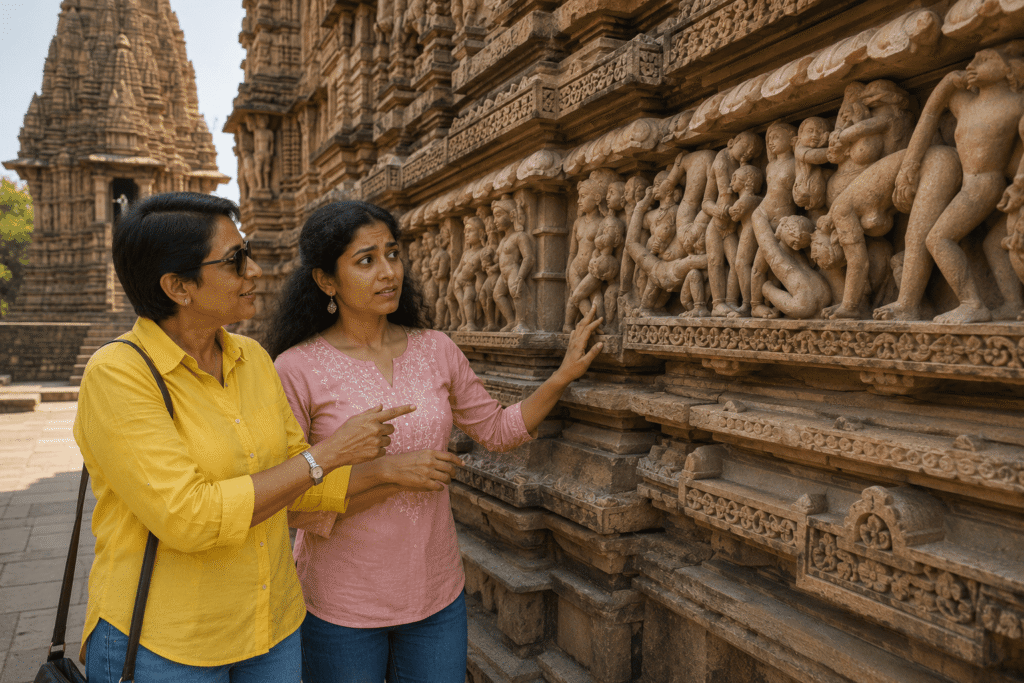
Harry explains the intricate Khajuraho temples carvings as Maya discovers the stories behind Khajuraho’s sculptures.
As we walked between the temples, Harry explained that most of the monuments were built between the 10th and 11th centuries under the Chandela dynasty. The rulers created Khajuraho as an important centre of art, religion and culture, bringing together Hindu and Jain traditions in an extraordinary temple complex.
He told us that the temples were not built all at once. They developed over generations, with successive Chandela rulers contributing to this remarkable landscape of stone temples and sculpture.
Harry also explained the name Khajuraho, traditionally associated with khajur, the Hindi word for date palm. Legends say that the settlement was once surrounded by palm trees, although the exact origin of the name is not certain.
Today, around 20 temples survive, grouped broadly into the Western, Eastern and Southern groups. The Western Group contains the most famous monuments, including the magnificent Kandariya Mahadeva Temple.
As Harry spoke, I began to understand that Khajuraho was not simply a collection of beautiful sculptures. It was the artistic expression of an entire civilisation—and we had only just begun to discover its story
Khajuraho Temples Architecture: Harry Explains
With Harry’s stories, the ancient Khajuraho temples carvings were no longer just stone—they began to speak to Maya.
As we continued walking, Harry drew our attention to the architecture. He explained that the temples are magnificent examples of the Nagara style of North Indian temple architecture, built mainly from carefully fitted sandstone.
“What makes Khajuraho special,” he told us, “is that the architecture and sculpture are not separate. They work together.”
The temples rise from their platforms with a series of halls leading towards the sacred inner chamber, or garbhagriha, crowned by soaring shikharas that seem to rise towards the sky. The walls are covered with an extraordinary rhythm of gods, goddesses, musicians, dancers, mythical creatures and scenes from human life.
Harry also explained that the craftsmen fitted the stone blocks together with remarkable precision, using traditional construction techniques rather than relying on modern cement mortar.
The temple groups are generally divided into Western, Eastern and Southern groups. The Western Group is the largest and includes some of Khajuraho’s most celebrated monuments, such as Kandariya Mahadeva, Lakshmana, Vishvanatha and Devi Jagadambi.
Standing beneath the towering shikhara of Kandariya Mahadeva, I understood what Harry meant. At Khajuraho, the architecture itself seems to rise, move and breathe—and every surface tells another story..
Ten Famous Temples in Khajuraho: Walking with Harry
Harry and I continued walking through the temple groups, stopping at several of the monuments that make Khajuraho so extraordinary. Rather than rushing from one temple to another, he encouraged us to look at the details—the sculptures, the architecture and the different stories each temple seemed to tell.
Here are some of the temples he introduced to us:
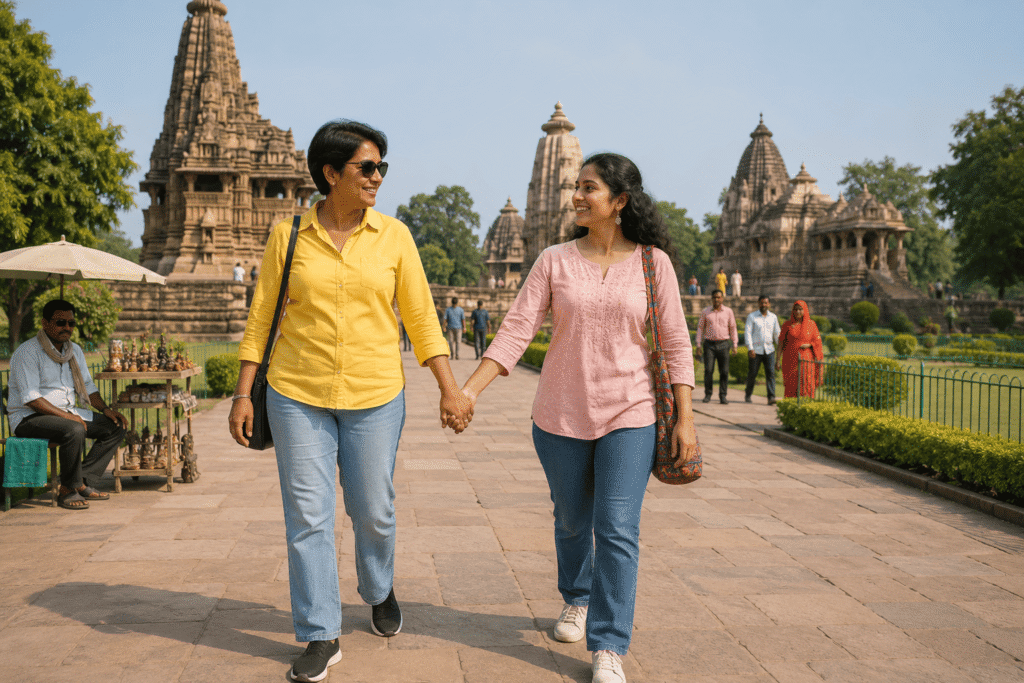
Maya and Harry explore the beautiful Khajuraho temples and peaceful pathways of the Western complex.
1. Kandariya Mahadeva Temple
Harry described Kandariya Mahadeva as the grandest of Khajuraho’s surviving temples. Dedicated to Shiva, its soaring central shikhara rises dramatically above a richly carved exterior, creating the impression of a sacred mountain.
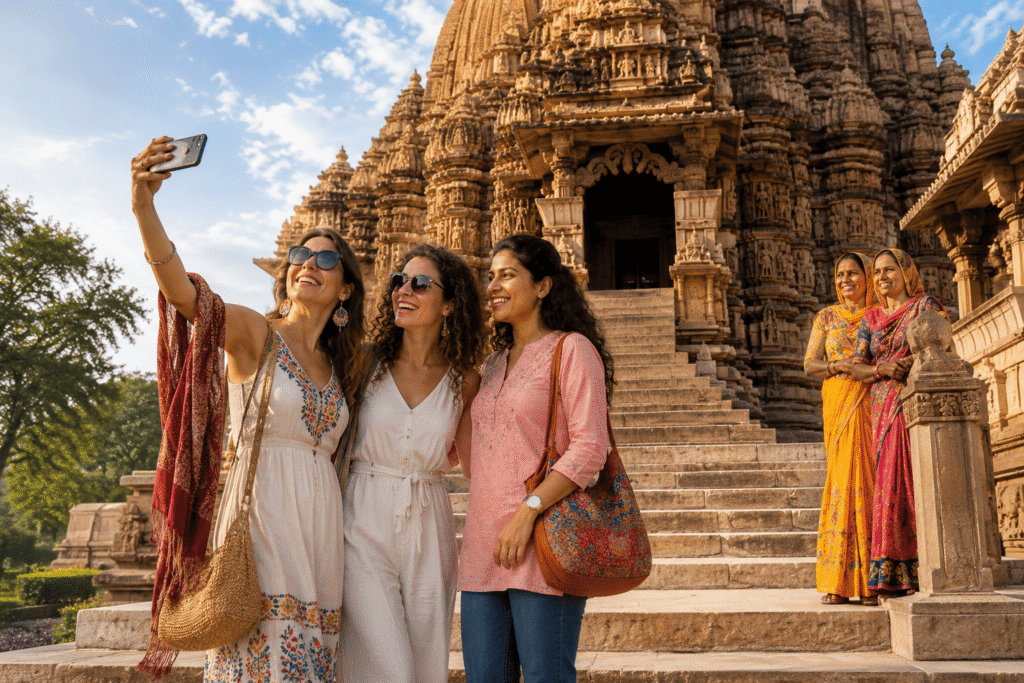
Kandāriyā Mahādeva Temple is the largest and most ornamented at Khajuraho Maya with Mexican Tourists
2. Chausath Yogini Temple
The Chausath Yogini Temple is one of the oldest surviving temples at Khajuraho and is associated with the worship of the 64 Yoginis. Unlike the elaborate later temples, its open-air circular arrangement gives it a very different character.
3. Lakshmana Temple
The Lakshmana Temple, dedicated to Vishnu, is one of the best-preserved temples of the Western Group. Harry pointed out its beautifully carved walls, showing deities, celestial figures, animals and scenes from human life.
4. Adinath Temple
Moving to the Jain temples, Harry showed us the Adinath Temple, dedicated to the first Jain Tirthankara, Adinath. Its elegant carvings demonstrate how Jain and Hindu artistic traditions existed side by side at Khajuraho.
5. Matangeshwar Temple
The Matangeshwar Temple is dedicated to Shiva and remains an active place of worship. Harry explained that this makes it especially interesting because Khajuraho is not simply an archaeological site—the tradition of worship continues here.
6. Javari Temple
The graceful Javari Temple belongs to the Eastern Group and is dedicated to Vishnu. Its elegant proportions and beautifully carved entrance make it one of the smaller temples worth stopping to appreciate.
7. Devi Jagadambi Temple
At the Devi Jagadambi Temple, Harry drew our attention to the richly decorated walls and graceful female figures. The temple is often associated with the goddess Jagadambi, although its original dedication has been the subject of scholarly discussion.
8. Chitragupta Temple
The Chitragupta Temple is particularly interesting because it is dedicated to Surya, the Sun God. Harry pointed out the magnificent image of Surya and the temple’s finely carved exterior.
9. Parshvanatha Temple
The Parshvanatha Temple is the largest of Khajuraho’s Jain temples. Its exterior is covered with exceptionally detailed sculpture, including religious figures as well as scenes of everyday life.
10. Chaturbhuj Temple
Chaturbhuja Temple “One who has four arms” is an epithet of Vishnu. The temple was built by Yasovarman of the Chandela Dynasty in c. 1100 CE
Our final stop was the Chaturbhuj Temple, named for its four-armed image of Vishnu. Unlike most of the Western Group temples, it is located in the Southern Group and is particularly known for its impressive surviving Vishnu image.
By the time Harry finished explaining the temples, I realised that Khajuraho could never be understood by simply ticking monuments off a sightseeing list. Each temple had its own personality, its own architecture and its own story.
And having Harry beside us made the difference. He wasn’t simply telling me what I were looking at—he was teaching us how to look at Khajuraho.
Meditation on Khajuraho Temples: Sitting Under a Tree
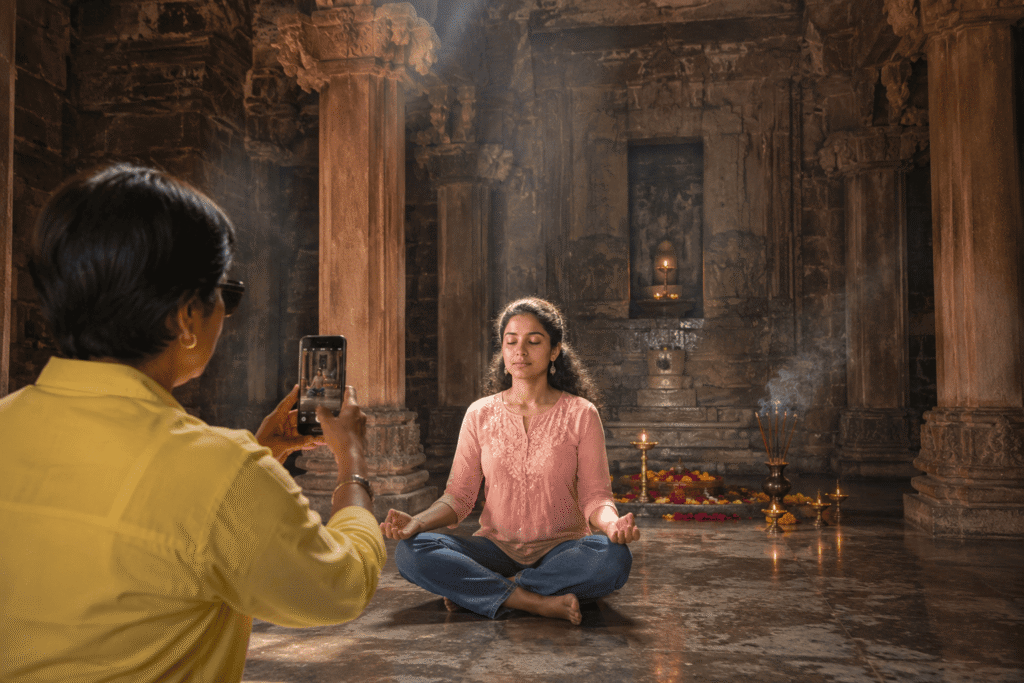
Maya pauses for meditation inside a Khajuraho temple, experiencing the peaceful spiritual atmosphere.
Later, we sat beneath a tree near the cafeteria inside the temple complex. A cool breeze touched my face, and after hours of walking among the temples, the quietness felt almost like meditation.
Harry went to get us something to drink. He returned with a cup of tea and a coffee for me, sat beside me and began talking about what we had seen.
His voice became quieter and more thoughtful.
“So much attraction of sex is for a momentary Samadhi,” he said. “You will be free from sex the day you begin to experience Samadhi without sex.”
Then he paused for a moment, as if letting the words settle into the silence around us.
“Lust, anger, greed, and attachment—these all belong to the material world,” he added softly. “Only the one who triumphs over them can attain the state of meditation and reach the Divine.”
I looked at Harry. There was something very peaceful about the way he said it, as if he was not preaching, but simply describing something he had already understood within himself.
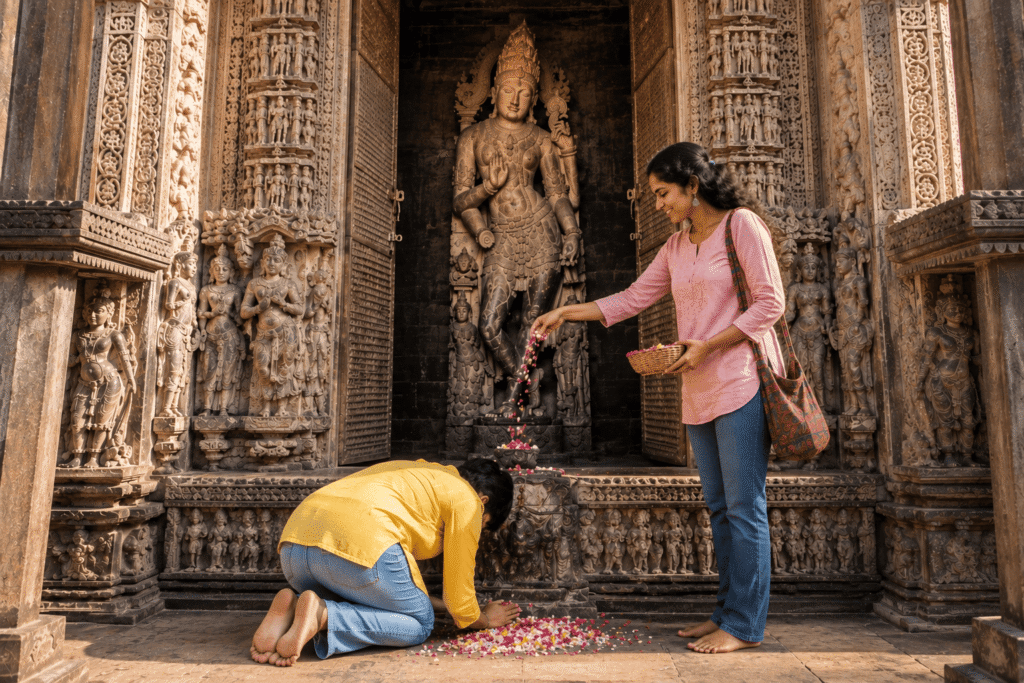
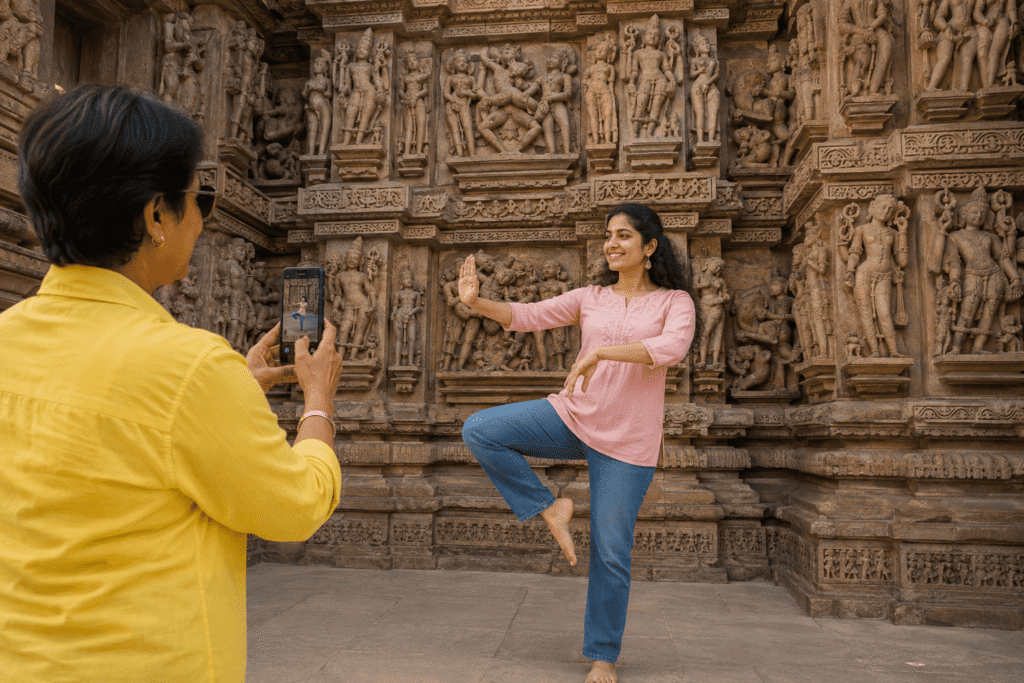
Maya connects her yoga journey with the graceful human forms carved into the walls of a Khajuraho temples.
He explained that the famous erotic sculptures are only a small part of Khajuraho. Travel books and photographs often make the temples appear like an ancient destination devoted to erotic art, but when you actually walk through the complex, you discover something completely different.
The temples are filled with gods, musicians, dancers, warriors, ordinary people, animals and scenes from everyday life. And after seeing the sculptures in their architectural and spiritual setting, the erotic images no longer seemed shocking to me. They seemed to be part of a much larger story about human life, desire, duty, and spiritual aspiration.
Harry connected this with the traditional Hindu ideas of Dharma, Artha, Kama and Moksha—duty, prosperity, desire and liberation.
“Perhaps,” he said, “the lesson is not that desire should never exist. Perhaps the entire universe is encapsulated within the sculpture of Khajuraho; one must view it as a detached observer. What appears to offer pleasure is, in truth, only Maya—an illusion. And only when one learns to see through this illusion can renunciation arise, making way for true meditation within the temple of one’s own mind. The journey is to understand desire, experience life fully, and eventually move beyond attachment.”
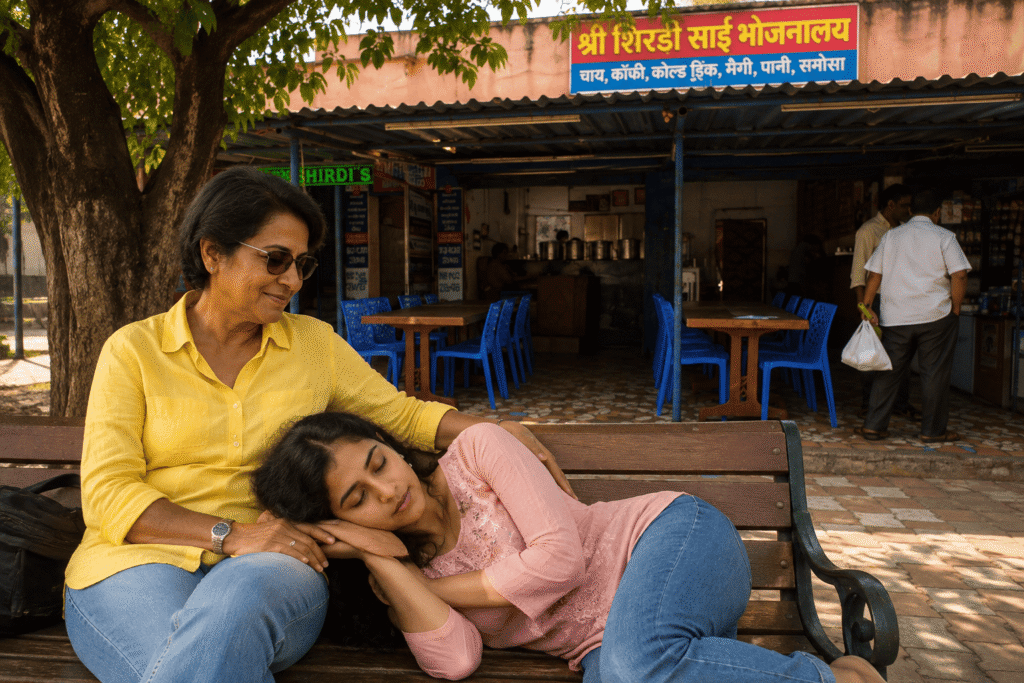
After listening to Harry’s meditative explanation of Khajuraho Temples, Maya rests peacefully beneath the tree.
While listening to Harry’s narration, I don’t know when I fell asleep.
When I opened my eyes, I found Harry sitting nearby, smiling at me.
“Shall I tell you the story again, Maya?” he asked with a gentle smile.
I smiled back at him.
“No, Harry. I think I have understood it differently now. You have changed the way I see Khajuraho. I came here expecting to see famous erotic sculptures, but you made me feel the deeper aura of Tantra—the connection between the human, the spiritual and the divine.”
I looked once more towards the temples.
The stones had not changed.
But my perspective had.
Khajuraho was no longer just a place of beautiful temples and famous sculptures. It had become a journey into human nature, spirituality, desire and the search for something beyond ourselves.
And perhaps that was the greatest lesson my Khajuraho tour guide Harry had given me.
Sometimes, you don’t need another temple, another photograph or another explanation.
You simply need to sit quietly, listen—and allow a place to change the way you see it.
If You want to Book a Tour Go With Harry – Contact
Maya’s Journey Home with Khajuraho Temples Tour Guide
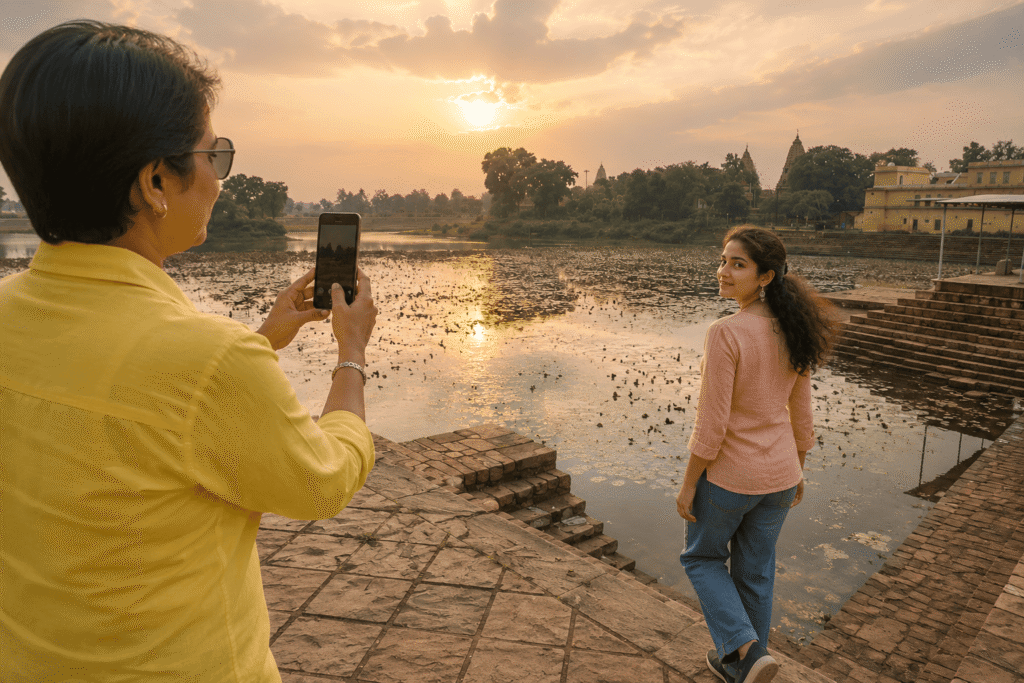
The journey home on the Vande Bharat Express gave Maya time to smile, reflect and relive the unforgettable stories of Khajuraho.
When I returned to Delhi, my friends kept asking me about my trip to the Chandela temples of Khajuraho.
I simply smiled and said, “My Khajuraho tour guide made it unforgettable.”
I shared my photographs in our WhatsApp groups and on Instagram, but photographs could never capture what I had experienced there.
I had gone to Khajuraho expecting to see beautiful temples and famous sculptures. I came back carrying stories, silence, spirituality and a completely different way of looking at those ancient stones.
Harry had not simply shown me Khajuraho; he had changed the way I saw it.
And whenever I look back at those photographs, I remember that peaceful morning, the temples glowing in the sunlight, the cool breeze beneath the tree—and Harry’s voice telling me that there was much more to Khajuraho than what the eyes could see.
That was my Khajuraho journey. And I will never forget it.
— Maya
FAQ’s: About the Golden Triangle Tour with Khajuraho Temples
1. Can I add Khajuraho Temples to a Golden Triangle Tour?
Yes. A Golden Triangle Tour with Khajuraho Temples combines Delhi, Agra and Jaipur with a visit to Khajuraho, allowing you to experience India’s famous Mughal and Rajput heritage alongside the remarkable temple art of the Chandela period.
2. How many days do I need for a Golden Triangle Tour with Khajuraho?
Ideally, allow 7–9 days for a comfortable private tour. This gives you enough time to explore Delhi, visit the Taj Mahal in Agra, discover Jaipur and spend meaningful time exploring the Khajuraho Temples without rushing between destinations.
3. Why visit Khajuraho on a private Golden Triangle Tour?
Adding Khajuraho gives your Golden Triangle Tour India itinerary a deeper cultural dimension. With a private guide, you can understand the temple architecture, intricate carvings, religious symbolism and history of the Chandela dynasty rather than simply seeing the monuments and moving on.
Intersted To Read More about Chandela Dynasty a Rajpoot Clan: Wikipedia
Golden Triangle Tour Reviews: What Travelers Say About Their Khajuraho Experience
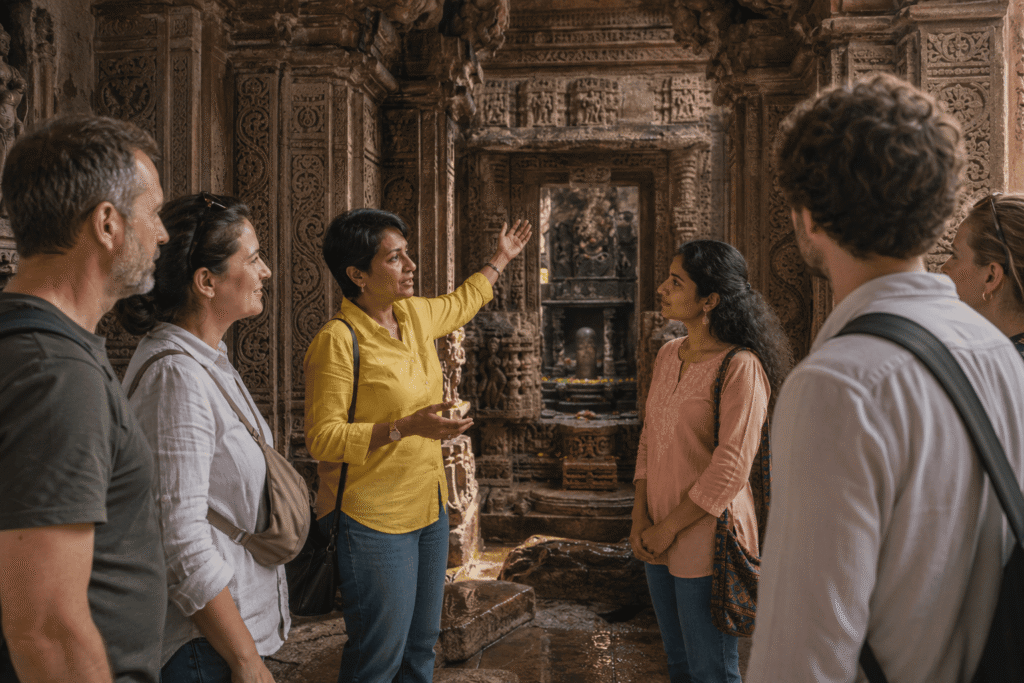
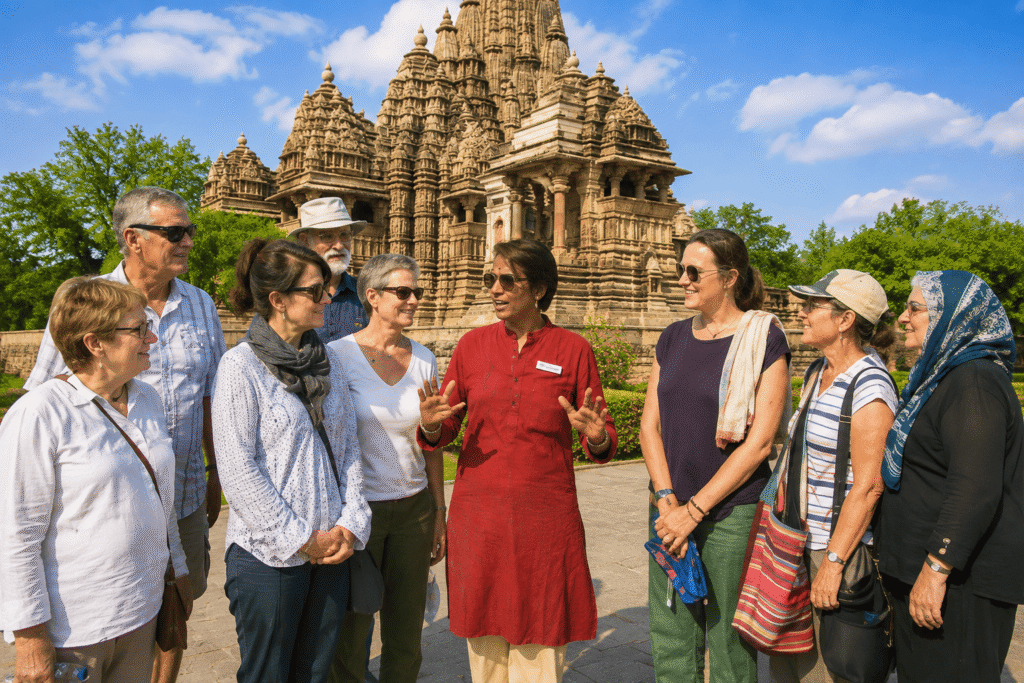
Harry explains the stories and architecture of Khajuraho temples to Canadian travelers on Golden Triangle Tour India
Our Golden Triangle Tour with Harry was wonderful from beginning to end. Delhi, Agra and Jaipur were incredible, but adding the Khajuraho Temples made the journey even more special. Harry explained the history and carvings so beautifully that we understood much more than we would have on our own.”
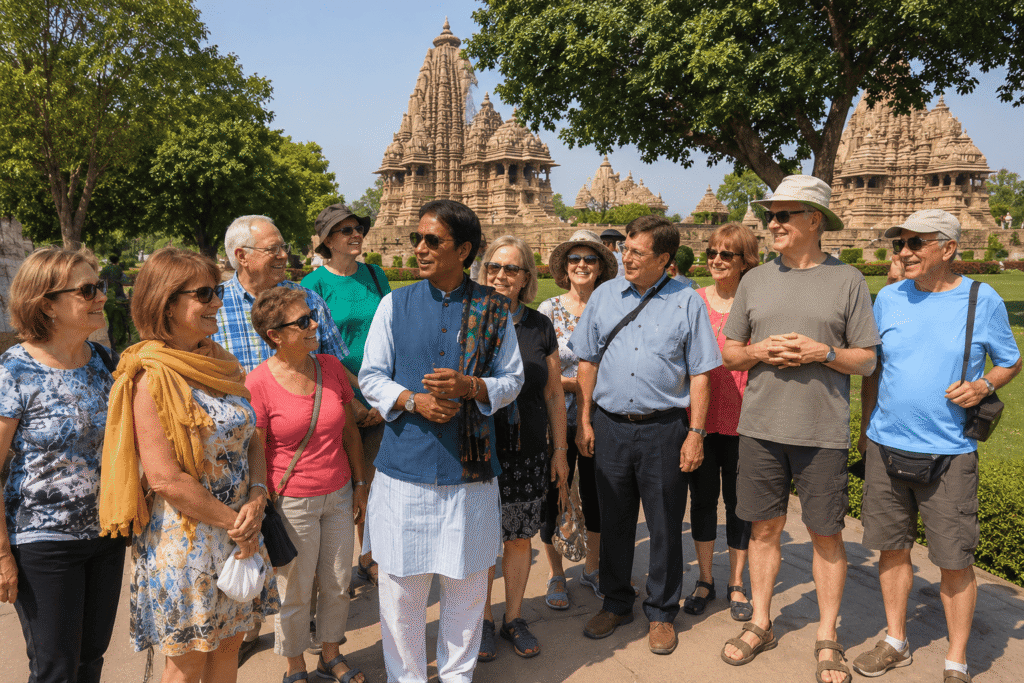
Harry shares the stories of the Khajuraho temples with American travelers during their Golden Triangle India Tour.
“We wanted more than a standard Golden Triangle Tour, and the Khajuraho extension was the perfect choice. Our private guide made every temple visit easy and fascinating, sharing stories about the Chandela dynasty, the architecture and the meaning behind the sculptures. It was one of the highlights of our India trip.”